
For most facilities, the coating is not the expensive part of a floor project. The shutdown is. A distribution center that cannot ship, a plant line that cannot run, or a kitchen that cannot open costs more per day than the entire flooring contract in many cases.
That pressure produces two bad outcomes. Either the project gets postponed for years while the slab keeps degrading, or it gets compressed so hard that prep and cure get short-changed and the floor fails early — which means doing the whole shutdown again.
There is a better path, and it starts with understanding where the downtime actually comes from. Almost none of it is the time spent applying material. This article covers how commercial epoxy projects get scheduled around live operations, which levers genuinely shorten the outage, which ones only appear to, and what you as the owner control.
Downtime is cure time, not application time
Rolling a coat of epoxy across an open bay is fast. What takes the calendar is everything around it:
- Clearing the space — moving racking, equipment, inventory, and vehicles out of the work zone.
- Surface preparation — grinding or shot blasting to profile, removing old coatings, repairing cracks and spalls. On a bad slab this is the majority of the schedule.
- Cure intervals between coats — each layer has to reach a recoat window before the next goes down.
- Return-to-service cure — the wait between the final coat and the moment forklifts and racking can come back.
Of those four, only the second is compressible by working harder. The others are compressed by planning, chemistry selection, and sequencing. That distinction is the whole game. The stage-by-stage breakdown in our guide to the commercial epoxy floor installation process shows where each hour actually goes.
Price the shutdown before you pick the schedule
Before any scheduling conversation, put a number on what a day of lost use costs you. Not a vague sense — an actual figure that includes lost production or revenue, idle labor, overtime to catch up, expedited freight, and any contractual penalties for missed commitments.
That number changes every decision that follows. If a day of downtime costs $2,000, a weekend shutdown with a conventional epoxy build is almost certainly the right economic answer. If it costs $80,000, paying a premium for faster-cure chemistry, a larger crew, and night work is trivially justified. Most facilities have never calculated it, and so they optimize the wrong variable — the flooring invoice instead of the outage.
Six levers that genuinely shorten the outage
1. Zone the work
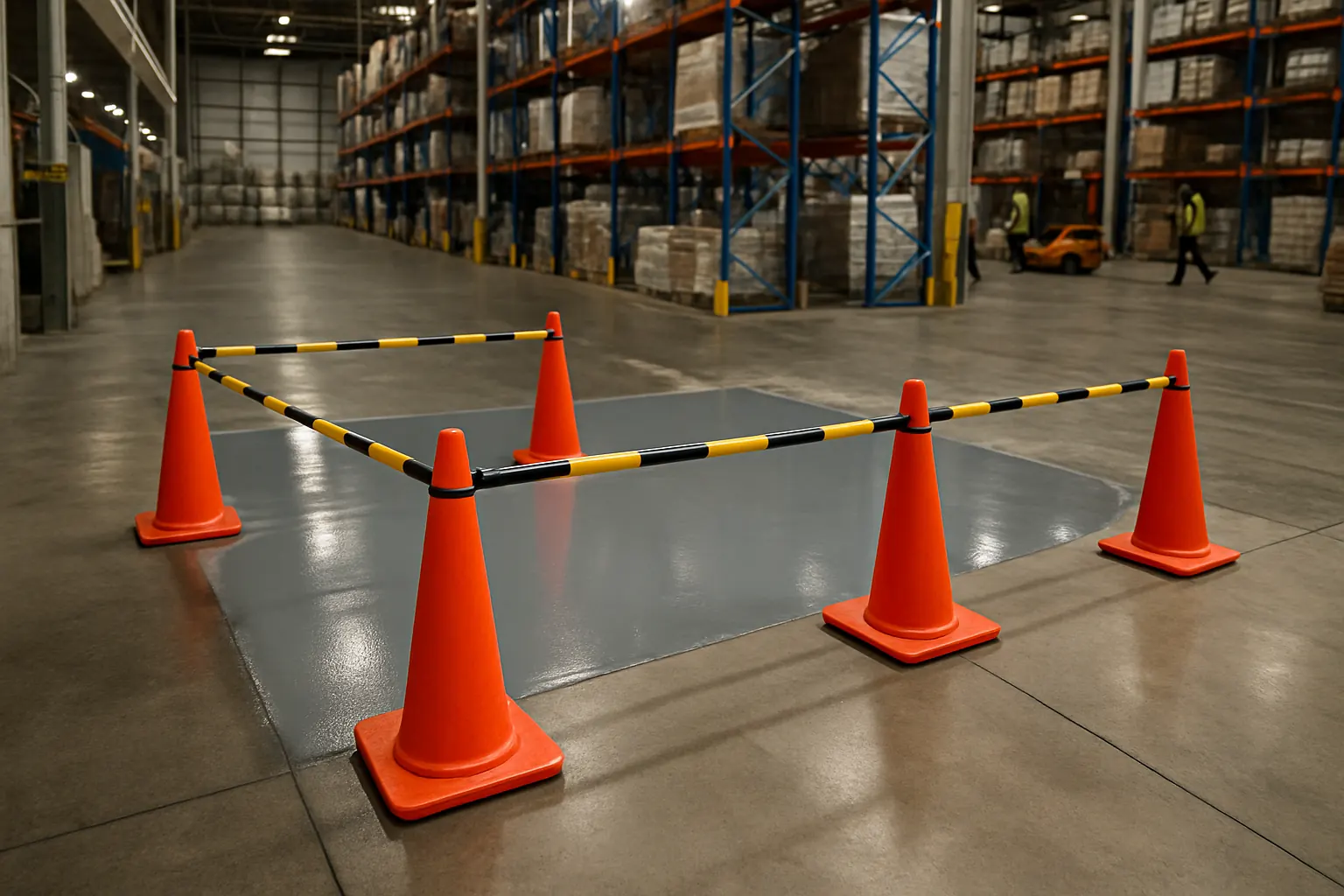
Phasing is the most reliable tool and the one most owners underuse. The floor gets divided into zones, and each zone runs the full sequence — clear, prep, prime, build, topcoat, cure — while the rest of the facility operates. Containment walls and negative air keep dust out of live areas.
Zoning works especially well in warehousing and distribution, where inventory can be consolidated, and in plants where individual lines can be idled in rotation. It costs more in total labor because crews mobilize repeatedly and edge transitions have to be detailed, but it can reduce the true operational outage to nearly zero.
The detail that matters is where the zone joints land. They should fall at control joints, column lines, or natural traffic breaks — never in the middle of a high-traffic aisle, where a cold joint between phases becomes a visible line and a wear point.
2. Use the shutdowns you already have
Nearly every facility has planned downtime it is not thinking of as flooring time: annual maintenance shutdowns, holiday closures, seasonal slow weeks, plant vacation periods, and in schools and universities, summer break. Booking a floor into an outage that already exists converts the most expensive component of the project to zero.
The catch is lead time. These windows book out months in advance for any competent installer, and prep surprises inside a fixed window are far more painful than in an open schedule. Assess the floor well before the window, not the week of.
3. Choose chemistry with the schedule in mind
Cure speed varies enormously between coating families. Standard epoxy commonly needs somewhere in the range of 12 to 24 hours between coats and a few days before heavy traffic. Fast-cure systems can compress that to hours, making same-day or overnight turnarounds possible on the right project.
That speed is not free. Faster chemistry has shorter pot life and a much less forgiving working window, which demands more crew and more discipline on the floor. It also generally costs more per square foot. And it does not shorten prep, which is usually the bigger half of the schedule anyway. Our comparison of epoxy, polyaspartic, urethane and polyurea lays out where each one earns its keep.
The common and sensible compromise on schedule-critical work is a conventional epoxy body with a fast-cure topcoat — you keep the economics and build of epoxy while pulling the final return-to-service milestone forward.
4. Scale the crew to the window
Prep is parallelizable. Two grinders and a shot blaster running simultaneously with adequate dust collection cover ground proportionally faster. Application is parallelizable too, up to the limit imposed by pot life and wet edge.
Ask bidders explicitly how many people and how many machines they intend to put on your floor, and whether those are their own crews. A contractor who self-performs can add crew from within; one who brokers the work is negotiating with someone else’s schedule.
5. Do everything possible before the clock starts
A surprising amount of the project does not require the floor to be out of service:
- Site assessment and moisture testing, done weeks ahead.
- System selection, submittals, and color approval.
- Material staged on site so no one waits on delivery mid-shutdown.
- Temporary power, heat, and ventilation arranged and tested.
- Containment framing pre-built.
- Racking disassembly plan and labor booked.
- Drain, trench, and threshold details decided.
Moisture testing in particular has to happen early, because the result can change the entire system and add a mitigation coat to the schedule. Discovering a vapor problem on day one of a three-day shutdown is how projects blow up. The methods and timing are covered in our article on concrete moisture testing and MVER.
6. Control temperature
Cure rate is temperature dependent. A slab at 50°F cures dramatically slower than the same slab at 70°F, and in an unheated Chicagoland warehouse in January that difference can add a full day to return-to-service. Bringing the building and, more importantly, the slab up to temperature before work begins is one of the cheapest schedule accelerators available.
Use indirect-fired heaters. Direct-fired units dump combustion moisture into the space, which can cause blush and hazing on curing epoxy. And bring the heat on early — concrete has enormous thermal mass and takes far longer to warm than the air above it.
Two schedules, same floor
Here is how the same 20,000 square foot warehouse floor might be approached two different ways. These are illustrative planning shapes, not quotes — actual durations depend entirely on slab condition and system.
| Factor | Full shutdown, single mobilization | Zoned, four phases |
|---|---|---|
| Operational outage | Entire facility, consecutive days | One zone at a time; facility keeps running |
| Total project calendar | Shortest | Longer, spread over weeks |
| Flooring cost | Lower — one mobilization, continuous work | Higher — repeat mobilization, containment, edge details |
| Total cost including lost operations | Higher when downtime is expensive | Usually lower for high-value operations |
| Material handling burden | Everything moves once | Inventory shuffles repeatedly |
| Appearance | Seamless field | Phase joints at planned locations |
| Best fit | Seasonal shutdown, new construction, low-cost downtime | 24/7 plants, hospitals, live distribution |
What the owner controls
Installers get blamed for schedule slips that were owner-side all along. The items below are yours, and they are usually on the critical path:
- An empty floor. Fully cleared, including the pallet in the corner and the cart nobody claims. Partial clearing forces the crew to work around obstacles and re-mobilize.
- Racking. Disassembly and reinstallation is often the longest single task in a warehouse project and it is rarely in the flooring contract. Book it separately and early.
- Access and security. Off-hours badge access, dock availability, elevator or freight access, and a named contact reachable at 5 a.m.
- Power. Grinders, blasters, and dust collectors draw real current, frequently three-phase. Confirm the panel can support it.
- Utilities and drains. Any drain, trench, or plumbing work has to be finished and inspected before coating.
- Traffic discipline after the pour. The crew can barricade the floor. Keeping people and equipment off it during cure is a management decision.
Where schedules actually slip
Unknown existing coatings. Nobody in the building knows what was installed in 1998. It turns out to be a thick, elastic membrane that shot blasting bounces off, and removal doubles.
Moisture that was never tested. Numbers come back high, a mitigation coat has to be added, and that adds both material lead time and cure days.
Substrate found under the old floor. Removing the coating exposes spalling, delamination, or crumbling concrete that has to be repaired and cured before anything goes over it.
Profile that will not take. Densified or heavily burnished slabs resist standard tooling and need more passes and different diamonds. This is a common surprise and one reason we verify concrete surface profile against replica chips rather than by pass count.
Cold building. Heat arrives late, the slab is still at 45°F, and cure times stretch.
Racking that was not booked. The floor is ready and the racking crew cannot come until next week.
The way to defuse most of these is a thorough pre-project assessment with test cuts into the existing coating, moisture probes in the slab, and a written contingency for what happens if the substrate is worse than it looks.
Downtime patterns by facility type
Warehouse and distribution. Racking is the constraint, not the coating. Zoning by aisle bank with consolidated inventory is standard practice across facilities in Bolingbrook, Aurora, and the I-55 and I-90 corridors.
Food and beverage. Sanitation windows and production schedules are rigid, and the coating has to be fully cured before washdown chemicals touch it. Food plant floors usually run zoned around cleaning cycles, with coving added at wall junctions during the same phase.
Healthcare and labs. Infection control requirements dominate. Containment, negative air, and low-odor systems matter more than raw speed, and work is typically confined to small areas with strict barriers.
Automotive and service bays. Bay-by-bay phasing lets the shop keep earning. Oil contamination in the substrate is the usual schedule risk.
Retail and hospitality. Overnight and early-morning work, with the space presentable before opening. Fast-cure topcoats earn their premium here more than anywhere else, and UV-stable finishes like ArmourPro UV 125 matter where daylight reaches the floor.
The false economy of over-compressing
There is a floor under how fast this can go, and pushing past it is how you end up doing the project twice. Coating over a slab that has not been properly profiled, over primer that missed its recoat window, over concrete that is still too cold, or letting loaded racking back on a floor that is hard but not fully crosslinked — every one of those buys a day now and costs a full replacement later.
A competent installer will tell you when a requested schedule is not achievable. That refusal is worth more than a yes. Most of the failure modes in our breakdown of why epoxy floors fail started as a schedule decision, not a product decision.
Frequently Asked Questions
Can an epoxy floor be installed overnight?
For limited areas with sound concrete and fast-cure systems, yes — overnight and early-morning installations are routine in retail, restaurant, and service environments. It requires a small footprint, an adequate crew, controlled temperature, and a substrate that does not need heavy removal. Large areas or floors needing significant prep are not overnight candidates.
Do we have to move all the racking?
Out of the zone being worked, yes. Coating cannot go under a rack foot and be expected to perform, and the prep equipment cannot reach. Phasing lets you move racking in sections rather than emptying the whole building at once, which is usually the difference between a feasible project and an impossible one.
How long before forklifts can drive on it?
Commonly in the range of 48 to 72 hours after the final coat at around 70°F, with cooler conditions extending that. Point loads from racking and hard-wheeled equipment are more demanding than tires, so rack reinstallation is typically scheduled at or after the vehicle milestone, not before.
Will the smell affect the rest of the building?
Most modern commercial epoxy systems are low-odor or low-VOC, but there is still odor during application and early cure. With containment, negative air, and exhaust routed outside, adjacent areas generally stay usable. In hospitals, labs, and food production, that containment plan should be written into the scope rather than assumed.
Is winter a bad time to do this in Chicagoland?
Not if temperature is managed. Winter is often the best scheduling window because facilities are slower and installer calendars are more open. It does require indirect-fired heat, enough lead time to bring the slab up to temperature, and a realistic allowance for slower cure. Projects run year-round across our Chicagoland, Northwest Indiana, and Southeast Wisconsin service area.
What is the single best way to shorten the outage?
Start earlier. A floor assessed and tested three months ahead can be scheduled into existing downtime, phased sensibly, and specified with no surprises. A floor assessed two weeks before a hard deadline gets whatever schedule the substrate dictates.
Let’s build the schedule around your operation
Every facility has constraints that do not show up on a floor plan — shift patterns, sanitation windows, seasonal peaks, racking, and the one line that can never stop. Our crews have been sequencing commercial and industrial floors around live operations for over 30 years, and we self-perform every stage, which means the schedule we commit to is one we control.
Tell us how your building runs and we will build the phasing plan around it. Reach us through our contact page or call (630) 919-5000.