
Two bids land on your desk for the same 30,000 square foot warehouse. One is 40% cheaper. Both say “epoxy floor coating system, two coats.” Both name reputable materials. Nothing on either page explains the difference.
The difference is almost always thickness. One contractor is installing a system at 8 mils and the other at 25 mils, and the paperwork does not say so because neither one wrote a number down. Film thickness is the single most consequential specification detail on a coating project, and it is also the easiest one to leave ambiguous.
Understanding two ideas — the mil and percent solids — lets you read any coating bid accurately, compare proposals that look nothing alike, and verify on site that you received what you paid for. Neither concept is complicated. Both get used to obscure rather than clarify far too often.
What a mil actually is
A mil is one thousandth of an inch: 0.001″. It is not a millimeter, and confusing the two is a factor-of-25 error that occasionally shows up in specifications written by people who do not work with coatings.
Some reference points to calibrate against:
- A sheet of printer paper: roughly 4 mils.
- A credit card: roughly 30 mils.
- A dime: roughly 53 mils.
- A quarter inch of urethane mortar: 250 mils.
So a “thin-film” epoxy system at 8 mils is about twice the thickness of a sheet of paper. A mid-build industrial system at 30 mils is about a credit card. That framing tends to make the stakes obvious in a way the number alone does not — the wear layer standing between a forklift and your concrete is measured in fractions of a hundredth of an inch.
Wet film versus dry film
Every coating gets measured twice, and the two numbers are different.
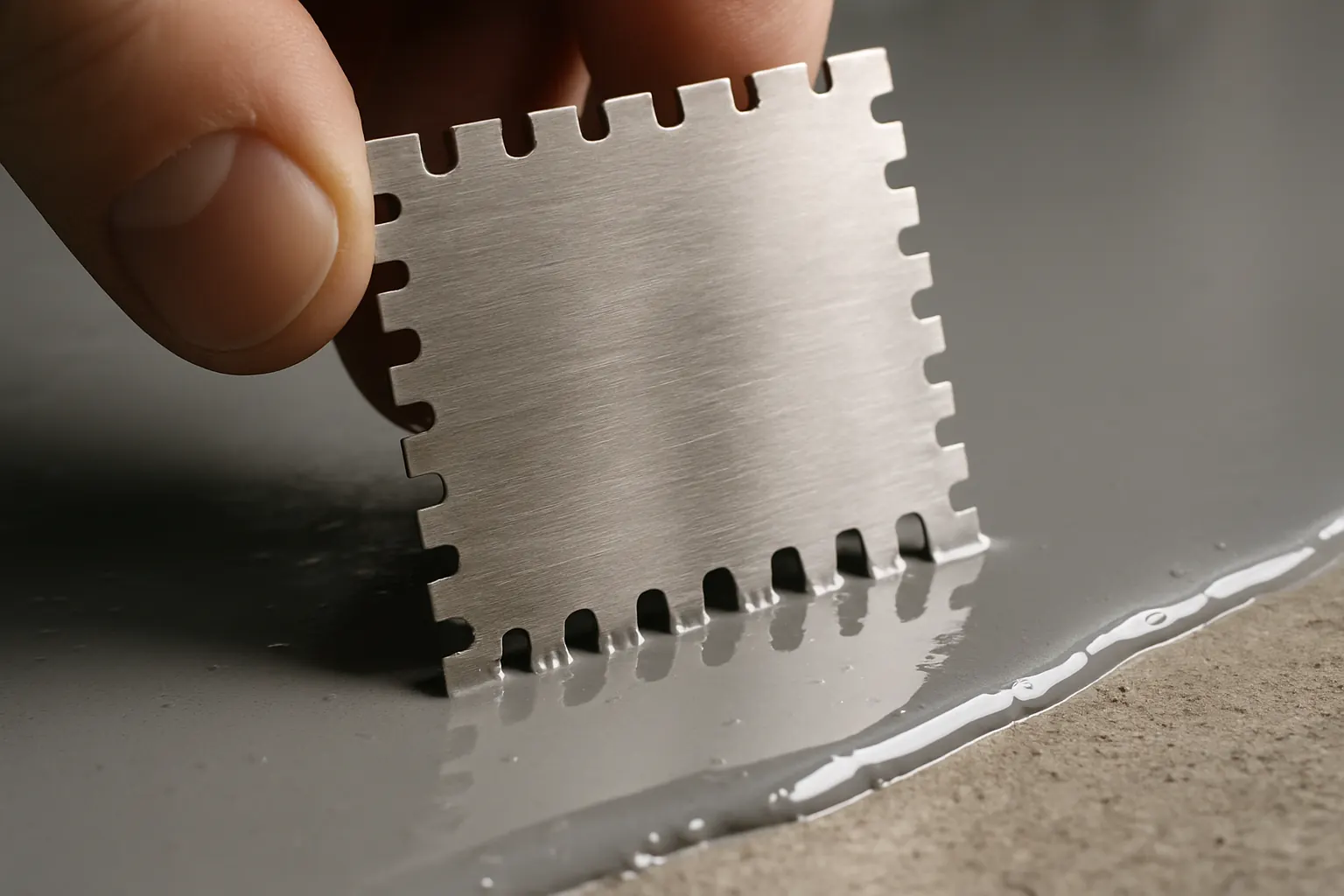
Wet film thickness (WFT) is how thick the material is at the moment it is applied, while still liquid. It is what a crew can measure in real time with a notched gauge, and it is the only thickness anyone can control during application.
Dry film thickness (DFT) is what remains after the coating cures. This is the number that matters for performance — abrasion life, chemical resistance, and impact protection all scale with DFT.
The gap between them is determined entirely by what is in the can besides resin.
What “100% solids” means
Solids content is the percentage of the applied material, by volume, that stays on the floor after curing. The remainder is solvent or water that evaporates into the air.
A 100% solids epoxy has no solvent or water carrier. Everything you apply stays. Twenty mils wet cures to twenty mils dry.
A 50% solids product loses half its volume during cure. Twenty mils wet gives you ten mils dry. A 30% solids product — common in water-based and heavily thinned coatings — gives you six mils dry from that same twenty mils wet.
The relationship is straightforward:
Dry film thickness = wet film thickness × percent solids
This is why “we applied 20 mils” is a meaningless statement without the solids content attached. It is also why 100% solids systems dominate industrial specification: you can build meaningful thickness in a single coat, there is no solvent to flash off, and VOC content is minimal, which matters for occupied buildings and for facilities with air permitting constraints.
Where lower-solids products still make sense
Not every layer wants to be 100% solids. Thinned or solvent-borne primers penetrate porous concrete more deeply because lower viscosity carries resin further into the substrate. Some thin urethane topcoats are formulated at lower solids specifically so they lay down at two or three mils without ropiness. The problem is not lower solids — the problem is lower solids being sold as though it delivers the thickness of a 100% solids build.
The coverage math
Coverage rate is where thickness and money meet, and the arithmetic is simple enough to check yourself.
One US gallon is 231 cubic inches. Spread it at exactly one mil thick and it covers 1,604 square feet. That number — 1,604 — is the constant behind every coverage calculation in the industry.
Theoretical coverage (sq ft per gallon) = 1,604 × percent solids ÷ target DFT in mils
A 100% solids epoxy targeting 10 mils dry: 1,604 ÷ 10 = about 160 square feet per gallon.
A 50% solids epoxy targeting the same 10 mils: 1,604 × 0.50 ÷ 10 = about 80 square feet per gallon. You need twice the material to reach the same finished thickness.
| Target dry film | 100% solids coverage | 60% solids coverage | Typical use |
|---|---|---|---|
| 3 mils | ~535 sq ft/gal | ~321 sq ft/gal | Thin topcoat |
| 5 mils | ~321 sq ft/gal | ~192 sq ft/gal | Primer, sealer coat |
| 10 mils | ~160 sq ft/gal | ~96 sq ft/gal | Light-duty build coat |
| 20 mils | ~80 sq ft/gal | ~48 sq ft/gal | Mid-build industrial |
| 30 mils | ~53 sq ft/gal | ~32 sq ft/gal | Heavy-duty build |
Two adjustments make these theoretical numbers real. First, waste: material stays in pails and on tools, and some is lost to overlap and edges. A loss factor is normal and should be planned for. Second, and much larger, is substrate profile. A slab ground to CSP 4 has considerably more surface area and deeper valleys than a slab at CSP 2, and the first coat has to fill that texture before it starts building above it. Deeply profiled floors consume noticeably more primer than the flat math predicts, which is one more reason profile and thickness get specified together — see our article on concrete surface profile and what the spec requires.
Why thickness drives service life
Abrasion removes coating from the top down. A 6-mil system and a 30-mil system in the same aisle wear at broadly the same rate per pass; the thicker one simply has five times as much material to give up before the concrete is exposed.
Thickness also governs impact resistance. A dropped fitting or a dragged pallet that would gouge through a thin film gets absorbed by a thicker build. And chemical resistance is a function of the barrier, not just the chemistry — a thin film has fewer mils for a spill to work through before it reaches the bond line.
This is why the honest comparison between two bids is cost per mil per square foot, not cost per square foot. A system at half the price with a third of the thickness is not a bargain, and it will need replacement — including a second full shutdown — years earlier. The shutdown is usually the expensive half, as covered in our guide to minimizing facility downtime during an epoxy floor installation.
How bids hide thinness
Watch for these patterns when you are reading proposals:
- Coats instead of mils. “Two coats of epoxy” describes nothing. Two coats can be 6 mils or 40 mils. Always ask for dry film thickness per coat and total system DFT.
- Gallons with no coverage rate. A gallon count is only meaningful alongside the area and the solids content. Do the division yourself.
- Solids content omitted. If the bid does not state percent solids by volume, it cannot be evaluated. Request the product data sheet.
- “Industrial grade” and similar adjectives substituting for numbers.
- Coverage rates at the very top of the manufacturer’s published range. Data sheets often list a range; quoting the thinnest end is technically compliant and practically thin.
- Broadcast systems quoted without media weight. Pounds of flake or quartz per square foot is part of the system thickness, and skimping there shows up as a thin, translucent finish.
- No stated wet film verification procedure. If nobody is checking during application, nobody knows what went down.
Measuring thickness in the field
Wet film gauges
A notched wet film gauge — a small metal or plastic comb with graduated teeth — is pressed into the wet coating and read where the teeth transition from wetted to dry. It costs almost nothing, takes seconds, and is the standard method under ASTM D4414. A crew that is not using one is not controlling thickness; they are estimating.
Wet readings should be taken frequently and across the whole area, not once at the start. Application thickness drifts as squeegees wear, as material warms and thins, and as crews move from open field to congested areas.
Dry film measurement
Measuring cured coating on concrete is harder than on steel, because the magnetic and eddy-current gauges used on metal do not work over a non-conductive substrate. The practical options are destructive: a Tooke gauge cuts a precise V-notch and reads the layers under magnification, or a core or chip is taken and measured directly. Both leave a small repairable spot.
Because dry measurement is destructive, the real quality control happens at the wet stage. That is why the wet film gauge, boring as it is, is the most important instrument on the job.
Track material consumption
The simplest audit any owner can perform: count the empty kits against the square footage. If a 10,000 square foot area was specified at 20 mils with a 100% solids product, roughly 125 gallons plus waste should have been consumed. If 70 gallons were used, the floor is thin, regardless of what it looks like.
Typical system thicknesses
| System type | Typical total DFT | Common application |
|---|---|---|
| Thin-film epoxy with topcoat | Roughly 8–15 mils | Light commercial, storage, corridors |
| Mid-build epoxy system | Roughly 20–40 mils | Warehousing, light manufacturing, service areas |
| Broadcast flake or quartz | Roughly 30–125 mils | Healthcare, labs, kitchens, locker rooms |
| Self-leveling epoxy | Roughly 60–125 mils | Heavy manufacturing, floors needing leveling |
| Urethane cement mortar | Roughly 125–250+ mils | Food and beverage, wet processing, thermal shock |
These are general industry ranges, not prescriptions. The correct thickness for a given floor comes from traffic weight, chemical exposure, thermal conditions, and how flat the substrate already is. A food processing plant with daily hot washdown and a distribution warehouse with pallet jack traffic land in completely different places, and picking the right family before the right thickness is the subject of our comparison of epoxy, polyaspartic, urethane and polyurea.
When thicker is not better
Thickness is not a free variable you maximize. Real constraints push back:
Transitions and door swings. A 250-mil mortar is a quarter inch. At doorways, thresholds, and equipment pads that step has to be detailed, and door undercuts may need adjustment.
Exotherm and shrinkage. Thick pours of 100% solids epoxy generate heat as they cure. Exceeding the manufacturer’s maximum thickness per lift can cause excessive exotherm, cracking, or bubbling. Build gets applied in lifts for a reason.
Rigidity. A thick, rigid film over concrete that moves is a stress concentrator. On slabs with active joints or known movement, thickness has to be paired with proper joint treatment rather than coating straight over the joint and hoping.
Moisture drive. A thicker, denser film is less permeable, so vapor pressure from below has fewer escape routes and builds up at the bond line. That is why heavy systems demand rigorous concrete moisture testing and MVER evaluation before selection, not after.
Cost. Doubling thickness roughly doubles material and adds labor and cure time. Beyond what the environment requires, the money buys nothing.
Frequently Asked Questions
Is 100% solids epoxy always the better choice?
For build coats on commercial and industrial floors, generally yes — it delivers thickness efficiently, contains minimal VOCs, and does not shrink as it cures. For deeply penetrating primers on porous slabs and for very thin topcoats, a lower-solids formulation may perform better. The layer’s job determines the right product.
How thick should my warehouse floor coating be?
It depends on traffic and expectations rather than square footage. Light foot traffic and occasional carts can be served by a thin-film system. Loaded forklifts, steel wheels, and pallet drops call for a mid-build system, commonly in the 20 to 40 mil range, with heavier builds in impact zones and dock aprons. A site assessment produces a defensible number; a phone call produces a guess.
Can I add thickness to an existing floor later?
Sometimes. If the existing system is well bonded and compatible, it can be abraded and built up with additional coats. That decision should follow adhesion testing, because adding weight and rigidity on top of a marginal bond accelerates failure rather than delaying it. Bond problems are the most common root cause discussed in our breakdown of why epoxy floors fail.
Why did my floor wear through in high-traffic areas first?
Usually because it was applied thinner there, or because the whole system was thin to begin with. Thickness drops at the edges of a squeegee pass, in congested areas that get rolled rather than poured, and wherever a crew was working fast. Traffic then exposes exactly those spots first. Consistent wet film checking during application is what prevents it.
What should I ask a bidder about thickness?
Four questions: What is the dry film thickness of each coat and of the total system? What is the percent solids by volume of each product? What coverage rate in square feet per gallon are you basing the quantities on? How will wet film thickness be verified during application? Any competent installer answers all four immediately.
Does the substrate profile change how much material I need?
Yes, significantly. A deeper profile means more surface area and deeper valleys for the first coat to fill, so primer and base coat consumption rises. This is normal and should be in the estimate, not a change order. It is one of several reasons prep and thickness get planned as a single decision in the commercial epoxy installation process.
Get numbers, not adjectives
A floor specification that states percent solids, dry film thickness per coat, total system thickness, coverage rate, and a verification method is a document you can hold someone to. One that says “commercial grade epoxy, two coats” is not.
National Epoxy installs American-made NexGen Polymers systems and has been doing commercial and industrial work for over 30 years, with crews that self-perform every stage across Chicagoland, Northwest Indiana, and Southeast Wisconsin. Every proposal we write states the system, the thickness, and how it will be verified — including on projects from Naperville to Schaumburg.
If you have a bid you want read honestly, or a floor that needs a real specification, reach us through our contact page or call (630) 919-5000.