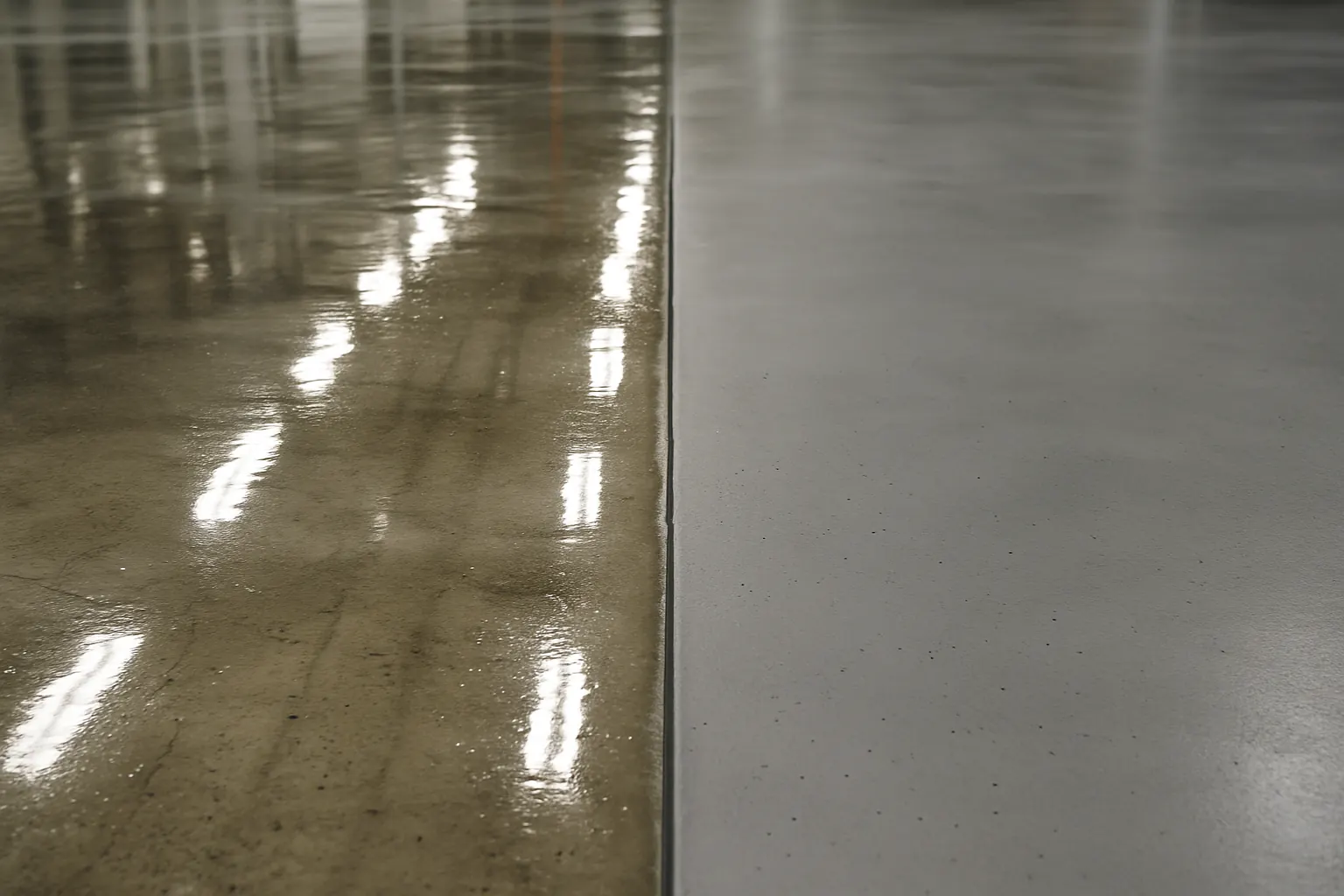
Ask three flooring contractors what your plant needs and you may get three different chemistries. One quotes epoxy. One says epoxy is outdated and pushes polyaspartic. A third recommends urethane cement. All three can be right, because they are describing different jobs.
These four materials — epoxy, polyaspartic, urethane, and polyurea — are not four brands of the same thing. They are different resin chemistries with genuinely different strengths, and the most important fact about them is one the marketing usually skips: on most commercial floors they are used together, not instead of each other. The industry-standard build for a durable commercial floor is an epoxy body with a urethane or polyaspartic topcoat, because each layer does what the other cannot.
This article explains what each chemistry actually is, where each one wins and loses, how they get layered, and how to tell whether a bid you are holding is specified sensibly for your building. If you are evaluating commercial and industrial epoxy floor installation options, this is the decision that has the largest effect on how the floor performs in year five.
The four chemistries in plain terms
Epoxy
Epoxy is a two-component thermoset: a resin and a hardener that react to form a rigid, densely crosslinked film. It is the workhorse of industrial flooring for three reasons — it bonds extremely well to properly prepared concrete, it builds thickness economically, and it has broad chemical resistance.
Its weaknesses are equally well established. Standard epoxy is aromatic, which means UV exposure causes it to amber and chalk. It is rigid, so it handles impact well but tolerates substrate movement and thermal shock poorly. And it cures relatively slowly, which lengthens project schedules.
Polyaspartic
Polyaspartic is technically a subset of polyurea — an aliphatic polyurea formulated with a polyaspartic ester that slows the reaction to a workable speed. It is UV stable, cures fast, has excellent abrasion and gloss retention, and can be applied across a much wider temperature range than epoxy, including in cold conditions where epoxy simply will not cure.
It is applied thin. Polyaspartic is a topcoat and finish chemistry, not a build chemistry — trying to get thickness out of it is expensive and can trap solvent or air. Pot life is short, sometimes measured in minutes, which demands an experienced crew and tight staging.
Urethane (polyurethane)
Aliphatic polyurethane topcoats are the traditional answer to epoxy’s UV problem. They are UV stable, more flexible than epoxy, highly abrasion resistant, and offer strong stain resistance against many of the things that mark up an epoxy surface.
Like polyaspartic, urethane is a thin-film topcoat, commonly applied at a few mils. It is also moisture-sensitive during application and cure — high humidity or a damp substrate can cause bubbling and hazing.
Note that “urethane” in flooring can mean two very different products. A urethane topcoat is a thin clear or pigmented wear layer. Urethane cement, sometimes called urethane mortar or cementitious urethane, is a completely different, heavily filled trowel-applied system. More on that below, because confusing the two causes real specification errors.
Polyurea
Pure polyurea sets extremely fast — often in seconds to a minute — and is usually plural-component spray applied. It has very high elongation and flexibility, excellent impact resistance, and outstanding waterproofing behavior, which is why it dominates secondary containment, tank lining, and truck bed lining.
On floors, straight polyurea’s set speed is more liability than asset for a smooth finished surface. Its most common flooring roles are as a flexible joint filler, a crack-bridging membrane, or a base layer where substrate movement is expected. Aromatic polyurea is not UV stable; aliphatic versions are, at higher cost.
Side-by-side comparison
| Property | Epoxy | Polyaspartic | Urethane topcoat | Polyurea |
|---|---|---|---|---|
| Primary role | Primer and build coats | Fast-cure topcoat | Topcoat / wear layer | Membrane, joint filler, lining |
| Typical film thickness | 10–60+ mils in a system | 3–8 mils per coat | 2–5 mils per coat | Varies widely; often 20+ mils sprayed |
| Adhesion to concrete | Excellent | Good, usually over an epoxy primer | Applied over epoxy, not bare slab | Good with correct primer |
| UV stability | Poor (ambers and chalks) | Excellent | Excellent (aliphatic) | Poor if aromatic, good if aliphatic |
| Abrasion resistance | Good | Excellent | Excellent | Good to excellent |
| Chemical resistance | Broad, especially acids and solvents in the right formulation | Good; varies by formula | Good, strong stain resistance | Good; excellent water resistance |
| Flexibility / crack bridging | Low — rigid | Moderate | Moderate | Very high elongation |
| Thermal shock tolerance | Low | Moderate | Moderate | Moderate to high |
| Cure speed to foot traffic | Commonly 12–24 hours | Often 1–4 hours | Commonly 8–24 hours | Minutes |
| Application temperature range | Narrow; typically above 50°F | Wide, including cold conditions | Moderate; humidity sensitive | Wide |
| Working window for the crew | Forgiving | Short — minutes | Moderate | Very short; specialized equipment |
| Relative material cost per mil | Lowest | High | High | High |
The part most comparisons get wrong: these are layers
The “epoxy versus polyaspartic” framing is a sales device. In real commercial specification, the question is almost never which one — it is which combination.
A typical high-performance commercial floor is built like this:
- Primer — a low-viscosity epoxy that penetrates the prepared slab and creates the bond. If moisture numbers demand it, a moisture-mitigating epoxy membrane goes here instead.
- Body / build coat — epoxy, because epoxy gives you thickness and adhesion at the lowest cost per mil. Broadcast media (flake, quartz, aluminum oxide) goes into this coat if texture and slip resistance are needed.
- Grout or intermediate coat — usually epoxy, filling the voids between broadcast media.
- Topcoat — urethane or polyaspartic, supplying UV stability, abrasion resistance, stain resistance, and the final gloss level.
Each layer plays to its chemistry’s strength. Epoxy does what it is best at — sticking and building. The topcoat does what epoxy cannot — resisting sunlight, resisting wear, and cleaning up well. Specifying a floor as “all polyaspartic” means paying premium material cost for the build layers where epoxy would perform better and cheaper. Specifying it as “all epoxy” means accepting a surface that will yellow near daylight and dull faster underfoot.
The one practical exception is the very fast turnaround job — a retail or service space that must reopen the next morning — where an all-fast-cure build genuinely buys something the layered approach cannot. That is a schedule decision, not a performance one, and it is covered in more depth in our guide to minimizing facility downtime during a floor installation.
Where each chemistry earns its place
When epoxy is the right answer
Interior manufacturing and industrial floors with no significant UV exposure, where you need thickness, impact resistance, and broad chemical resistance at a rational cost. Epoxy is also the correct choice whenever a floor needs a genuine build — self-leveling installations, heavy broadcast systems, and anything that has to fill and smooth a rough substrate.
When polyaspartic earns the premium
Schedule-critical projects, cold-weather installations, and floors with real daylight exposure. A dock apron, a showroom, a retail floor under skylights, or a facility that cannot give you more than an overnight window. Polyaspartic also holds gloss noticeably better under foot traffic, which matters in hospitality and customer-facing spaces.
When urethane is the right topcoat
Most of the time, honestly. A urethane topcoat over an epoxy body is the default high-value commercial build. It is the sensible finish for warehouses, plants, kitchens, and back-of-house areas where you want abrasion and stain resistance without paying polyaspartic pricing across the whole floor. A urethane high-gloss topcoat also gives you a surface that cleans easily under an autoscrubber.
When polyurea makes sense
Where movement or water is the governing problem. Flexible joint fill in a floor with active control joints, crack-bridging membranes over slabs with known movement, secondary containment, and wet areas where a monolithic waterproof membrane is the point. It is a specialty tool, not a general floor finish.
Urethane cement is a different product entirely
Worth separating out, because it gets confused with urethane topcoats constantly. Urethane cement — also called urethane mortar or cementitious urethane — is a heavily filled, trowel-applied system typically installed at 1/8 to 1/4 inch or more.
Its defining properties are thermal shock resistance and moisture tolerance. It has a coefficient of thermal expansion close to concrete’s, which means it survives steam cleaning, boiling water spills, and freezer-to-ambient cycling that would pop a rigid epoxy off the slab. It also tolerates higher substrate moisture than most epoxy systems.
That makes it the standard answer in food and beverage processing — breweries, dairies, meat and poultry, commercial bakeries — and in any wet processing environment with daily hot washdown. It costs more and requires deep surface profile, commonly CSP 6 or above, which our article on concrete surface profile requirements explains in detail.
Selection by facility type
- Warehouse and distribution: epoxy build with a urethane topcoat. Add broadcast in pick aisles and dock areas for traction.
- Manufacturing and machine shops: mid-build to heavy epoxy, chemically resistant topcoat, flexible joint fill.
- Food, beverage, and commercial kitchens: urethane cement with integral coving, especially in hot washdown zones.
- Healthcare and labs: epoxy broadcast quartz with a chemically resistant topcoat, coved and seamless. Chemical exposure in life sciences spaces should drive the topcoat choice.
- Automotive service and dealerships: epoxy build with a UV-stable topcoat, formulated to resist hot-tire pickup. Front-of-house showrooms often justify polyaspartic.
- Retail and hospitality: polyaspartic or urethane finish for appearance and gloss retention; fast cure for overnight installation.
- Cold storage and freezers: urethane cement, applied with chemistry rated for the temperature.
- Aerospace and high-tolerance production: chemically resistant epoxy build with a topcoat matched to the specific fluids present.
Common mis-specifications
Aromatic epoxy as a final wear surface where sunlight reaches. It will amber. Dock doors, skylights, and glass-front showrooms all need a UV-stable topcoat.
Rigid epoxy in a thermal shock environment. Steam cleaning or hot product spills on a rigid coating over concrete causes differential expansion and delamination. That environment needs urethane cement.
Polyaspartic specified for build thickness. Expensive, and the wrong tool. Use epoxy for build and polyaspartic where fast cure and UV stability are needed.
A high-gloss topcoat in a wet area. Gloss looks impressive at handover and becomes a slip complaint the first time the floor gets wet. Broadcast aggregate and a matte or satin finish are the correct answer where water is present.
Any system specified before moisture testing. Vapor drive will lift a well-chosen system just as effectively as a poorly chosen one. Test the slab first — our guide to concrete moisture testing and MVER covers the methods.
Cost, realistically
Installed cost for commercial floor coatings commonly runs somewhere in the range of a few dollars to well over ten dollars per square foot, depending overwhelmingly on system thickness and how much preparation the existing slab requires. Thin-film epoxy with a urethane topcoat sits at the lower end. Broadcast quartz and flake systems sit in the middle. Urethane cement mortar sits at the top.
Two things distort those numbers more than chemistry does. The first is prep — a slab with a failed coating, oil contamination, or extensive spalling can carry more labor than the coating itself. The second is moisture mitigation, which adds a full membrane coat plus schedule.
The right way to compare bids is per-system-mil, not per-square-foot. A bid at a lower price with half the film thickness is not cheaper, it is smaller. Our article on mil thickness and 100% solids explains how to read those numbers and where bids hide thinness.
How to write the specification
- Describe the environment, not the product: traffic type and weight, chemicals present with concentrations, temperature range, cleaning method, slip requirement, and UV exposure.
- State each layer separately — primer, build, grout, topcoat — with a target dry film thickness for each and a total system thickness.
- Name the required substrate profile and require verification before priming.
- Require moisture testing after preparation, with results submitted before the system is finalized.
- Specify the finish characteristics: gloss level, color, and slip requirement, with a mock-up for approval.
- Require the manufacturer’s chemical resistance data for the specific substances your operation actually uses.
Frequently Asked Questions
Is polyaspartic better than epoxy?
It is better at some things and worse at others. Polyaspartic is faster curing, UV stable, and holds gloss better. Epoxy adheres better to bare concrete, builds thickness far more economically, and is more forgiving to install. On most commercial floors the right answer uses both — epoxy underneath, polyaspartic or urethane on top.
Will an epoxy floor turn yellow?
Standard aromatic epoxy will amber over time with UV exposure. Interior floors with no daylight generally stay stable for years. Floors near dock doors, under skylights, or behind glass need a UV-stable topcoat such as ArmourPro UV 125 to prevent it.
What causes hot-tire pickup?
Hot tires soften and plasticize a coating, and as they cool they grip and lift it. It is primarily an adhesion and cure problem — thin coatings, inadequate surface profile, or a floor put back in service before full chemical cure. A properly prepared, properly cured system with an appropriate topcoat resists it. This is one of several failure patterns detailed in our article on why epoxy floors fail.
Can polyaspartic go directly on concrete?
Some formulations are designed to, and it is done in fast-turnaround residential and light commercial work. On commercial and industrial floors it is normally applied over an epoxy primer, because epoxy penetrates and bonds to the substrate better and gives the system a more reliable foundation.
Which system lasts the longest?
Longevity is driven more by preparation and thickness than by chemistry. A thick, properly prepped epoxy system with a urethane topcoat in a suitable environment will outlast a thin premium coating on a poorly prepared slab every time. Match the chemistry to the environment, then put the money into film thickness and prep.
Can we recoat rather than replace?
Often, yes. If the existing system is well bonded and compatible, the wear layer can be abraded and a fresh topcoat applied — which is why planned topcoat renewal is a sensible maintenance strategy rather than waiting for failure. Whether your floor qualifies is determined by adhesion testing, not by appearance.
Get the system matched to your building
The right specification comes from the room, not the catalog. What runs on the floor, what gets spilled on it, how it is cleaned, how hot it gets, and how much daylight reaches it will point to one combination of layers and rule out the rest.
National Epoxy has been installing commercial and industrial floors for over 30 years, using American-made NexGen Polymers systems, with crews that self-perform every stage from prep through topcoat across Chicagoland, Northwest Indiana, and Southeast Wisconsin. We will walk your floor, test it, and tell you which system it actually needs — including when a less expensive one is the correct choice.
Reach us through our contact page or call (630) 919-5000.