Every flooring comparison a facility manager gets handed starts with the same number: dollars per square foot, installed. It is the easiest number to collect and the least useful number to decide on. A floor is not a purchase. It is a ten- to twenty-year operating commitment that consumes labor, chemicals, machine time, and — the expensive part — production hours every time it needs attention.
The three finishes that show up on most Chicagoland shortlists are resinous coatings (epoxy and its urethane or polyaspartic topcoats), polished concrete, and tile (quarry tile in kitchens, porcelain in front-of-house, VCT in light commercial). All three can be the right answer. None of them is the right answer everywhere, and the one that looks cheapest on bid day is frequently the one that costs the most by year seven.
This article breaks the comparison into the cost lines that actually move: installed cost, downtime, daily maintenance, repair, and end-of-life. It is written for people who have to defend a capital request, not for people shopping on price alone.
Why first cost is the wrong number to decide on
First cost is roughly 30 to 60 percent of what a floor will cost you over its service life, and the percentage shrinks the harder the environment is. In a wash-down food plant or a high-cycle warehouse aisle, the installed price can be a minority of total spend once you add scrubbing labor, chemical consumption, joint repair, and the shutdown hours you burn every time something has to be fixed.
The other reason first cost misleads: it is the line most easily manipulated by cutting the part of the job you cannot see. Surface preparation is typically 30 to 50 percent of a resinous flooring bid. A contractor who skips profiling and acid-etches or lightly broom-cleans instead can undercut a properly prepped bid substantially and still hand you a floor that looks identical on day one. It fails at month eighteen. Most of the failures we get called to repair trace back to prep, which is why understanding why epoxy floors fail matters more to your budget than any product datasheet.
So compare lifetime cost. Below is how each system actually behaves.
The three options, described honestly
Resinous coatings (epoxy, urethane, polyaspartic)
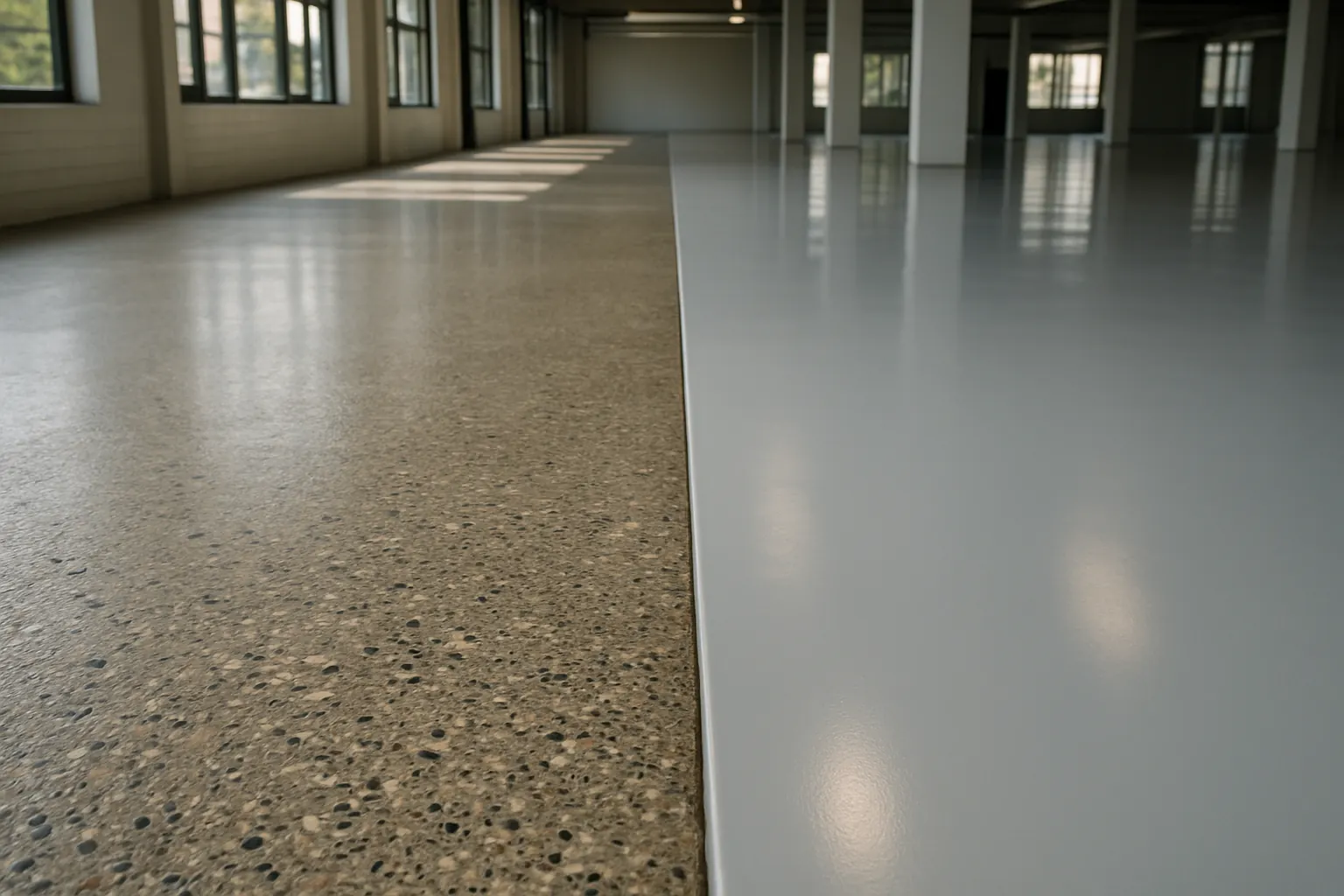
A resinous floor is a liquid-applied system bonded to the concrete slab. Typical builds run from a thin roller-applied coating at 10 to 20 mils, to a broadcast quartz or flake system at 1/8 inch, to a troweled urethane mortar at 1/4 inch for thermal-shock and heavy-impact service. Thickness is the primary durability lever, and it is also the primary cost lever.
Strengths: seamless and cleanable, chemically resistant, can be sloped and coved to drains, repairable in place, and available in specific performance grades. A 100% solids epoxy base like National Armour 100 under a urethane topcoat behaves very differently from a big-box thin coating, even though both get called “epoxy.”
Weaknesses: it is a bonded system, so it is only as good as the substrate and the prep. Moisture vapor emission from the slab will drive delamination regardless of the coating’s quality. UV exposure ambers standard epoxy, which is why exterior or heavily skylit spaces need a UV-stable topcoat such as ArmourPro UV 125.
Polished concrete
Polished concrete is not a coating. It is the existing slab, ground and honed through progressive diamond grits, densified with a chemical hardener, and burnished. Nothing is added on top except sometimes a thin guard or stain protector.
Strengths: nothing to delaminate, because nothing is bonded on. Very long service life in dry environments, excellent abrasion resistance under hard-wheel traffic, low material cost, and no recoat cycle in the conventional sense. In a big-box retail floor or a dry distribution center, it is often the most economical lifetime choice.
Weaknesses: it inherits everything wrong with your slab. Cracks, patches, color variation, old adhesive shadows, and spalling all become the finished floor’s appearance. It is porous relative to a coating — food acids, oils, brake fluid, and dyes stain it. It cannot be coved to the wall, it cannot be sloped to a drain, and it will not survive thermal shock from steam or boil-over. It also requires a slab thick enough and hard enough to take grinding, which rules out some older or over-troweled floors.
Tile (quarry, porcelain, VCT)
Quarry tile with epoxy grout is still the specified default in a lot of commercial kitchens, and for good reason: it handles thermal shock and heavy grease well, and it has decades of precedent behind it.
Strengths: excellent heat and thermal-shock tolerance, proven longevity in kitchens when installed with a full mortar bed and epoxy grout, and individually replaceable units.
Weaknesses: grout joints. A quarry tile kitchen has a very large amount of linear grout, and every joint is a seam that harbors soil, absorbs grease, and eventually fails. Sanitation labor per square foot is materially higher than a seamless floor. Loose or hollow tiles crack under impact and pallet-jack wheels, and replacement is a patchwork that never quite matches. In a food environment, the grout joint is also the inspection finding you get written up for. Facilities dealing with USDA or FDA sanitation expectations increasingly move to seamless food and beverage flooring systems for exactly this reason.
Side-by-side: how the cost lines compare
These are industry-general ranges for commercial and industrial work, not quotes. Actual numbers depend on square footage, slab condition, access, shift restrictions, and system spec.
| Cost line | Resinous / epoxy | Polished concrete | Tile (quarry / porcelain) |
|---|---|---|---|
| Typical installed cost | Commonly $4–$12/sq ft; urethane mortar systems higher | Commonly $3–$9/sq ft depending on grit level and slab repair | Commonly $12–$30/sq ft with mortar bed and epoxy grout |
| Downtime to install | 2–5 days typical; fast-cure options can return service overnight | 2–5 days; dust-controlled but noisy | 1–3 weeks including cure of bed and grout |
| Seamless / sanitary | Yes — coving and drain slope available | Seamless but porous; no coving | No — grout joints throughout |
| Chemical resistance | High, and specifiable by system | Low to moderate; stains | Tile high, grout variable |
| Thermal shock tolerance | Urethane mortar excellent; standard epoxy limited | Poor | Excellent |
| Daily cleaning effort | Low — autoscrub, no joints | Low — autoscrub, dust mop | High — joint scrubbing, degreasing |
| Typical maintenance event | Topcoat refresh every 5–10 years in traffic zones | Re-burnish / re-polish every 3–7 years | Regrout and replace cracked units, ongoing |
| Repairability | Good — patch and blend in place | Fair — repairs are visible | Fair — unit replacement, color mismatch |
The line most owners forget: downtime
Downtime is usually the largest hidden number in the comparison, and it is the one only you can price. A production line that generates several thousand dollars an hour of throughput turns a two-week tile installation into a six-figure decision that has nothing to do with material cost.
Resinous systems win here more often than not, because they can be phased bay by bay, installed on weekends or third shift, and — with fast-cure chemistry — returned to foot traffic in hours instead of days. Tile cannot be rushed; the mortar bed and grout cure on their own schedule. Polished concrete sits in between: the grinding itself is fast, but slab repair, joint filling, and dust control add days, and adjacent areas often have to be curtained off.
When you compare bids, ask each contractor to price the same phasing plan. A bid that assumes a clear, empty building over five consecutive days is not comparable to one that assumes weekend-only work around live equipment. This is one of the most common apples-to-oranges traps, and it is covered in more detail in our guide to reading a flooring quote and what belongs in the scope of work.
Maintenance and consumables over ten years
Build a simple annual number for each option using the inputs you already track:
- Labor hours per cleaning cycle. Grout joints add scrub time. A seamless floor cleans at autoscrubber speed; quarry tile frequently needs deck brushing on top of that.
- Chemical cost. Aggressive degreasers and low-pH cleaners are consumables, and they are also the fastest way to void a coating warranty if the manufacturer’s chemical list excludes them.
- Machine wear and pad/brush replacement. Higher on aggressive or uneven surfaces.
- Planned refresh. Budget one topcoat refresh in high-traffic zones during a ten-year window for resinous, one re-polish for polished concrete, and ongoing joint repair for tile.
- Unplanned repair. Impact damage, forklift gouges, chemical spills, hot-tire pickup in vehicle areas.
The pattern that usually emerges: tile has the highest recurring labor, polished concrete the lowest recurring labor in a dry building, and resinous the lowest total when you include sanitation risk, chemical exposure, and repairability. In wet or chemically loaded environments, resinous is usually the only option of the three that holds its cost curve flat.
Repair, recoat, and end of life
End of life is where the three diverge most sharply, and it rarely appears on a bid comparison at all.
A resinous floor is designed to be recoated. When the topcoat wears through in the main aisle, you abrade and recoat that zone. The base build stays. You are buying a topcoat, not a floor, and downtime is a weekend. That only holds if the original installation was properly prepped and bonded — a delaminating floor cannot be recoated, it has to be removed, and removal of a failed system is expensive.
Polished concrete does not really end. It gets re-honed. The practical limit is how much slab you have left and whether the aggregate exposure still looks acceptable. Where it does fail as a decision is when the building’s use changes — the day a dry warehouse becomes a wet processing area, you are installing a coating anyway.
Tile ends one unit at a time, and then all at once. Owners typically tolerate patch replacement for years and then rip out the whole floor, including the mortar bed, which is a demolition cost that resinous and polished concrete never incur. Full tile removal down to sound substrate can approach the cost of the original installation.
Where each option actually wins
Rather than declaring a winner, match the finish to the load case:
- Dry distribution, big-box retail, hard-wheel traffic, no chemicals: polished concrete is frequently the lifetime cost leader. Consider a coating only if you need color coding, brightness, or dust control the slab cannot deliver.
- Wash-down food and beverage processing: urethane mortar with integral coving, sloped to drains. Thermal shock and daily caustic wash-down eliminate polished concrete and make grout joints a liability.
- Manufacturing and heavy industrial: a high-build resinous system chosen for impact and chemical exposure. See industrial flooring systems for how spec changes with the process.
- Warehouse aisles with forklift and pallet-jack traffic: resinous with the right thickness and striping, or polished concrete where the environment is dry. Our breakdown of warehouse floor coatings for forklift traffic covers the load and thickness decisions.
- Healthcare, labs, pharma: seamless resinous with coving, chosen for cleanability and chemical resistance. Polished concrete’s porosity is disqualifying in most pharmaceutical environments.
- Front-of-house retail and hospitality: genuinely a design decision. Porcelain tile, decorative flake, or polished concrete are all defensible; pick on appearance and slip resistance, then compare maintenance.
Build the model yourself before you take bids
You do not need a consultant for this. Put five rows in a spreadsheet for each option: installed cost, downtime cost, annual cleaning labor and chemicals, planned refresh events over ten years, and expected repair events. Multiply, add, divide by square feet. The answer is usually obvious within about fifteen minutes, and it is defensible to whoever signs the capital request.
Two inputs are worth getting right before you model anything. First, moisture. Ask whether anyone has run a moisture vapor emission or relative humidity test on the slab. If the slab is wet, a coating needs a moisture-mitigating primer and the cost changes; polished concrete and tile respond to slab moisture differently but are not immune. Second, slab condition. The prep method — diamond grinding versus shot blasting — depends on what is on the floor now and what profile the system requires, and it materially affects the bid.
If you want realistic ranges before you build the model, our commercial epoxy flooring cost guide explains what pushes a number up or down. And because the biggest cost variable is who installs it, run any shortlist through the questions used to vet a commercial flooring contractor before you compare price at all.
Frequently Asked Questions
Is polished concrete always cheaper than epoxy?
Not always, and not automatically. Polished concrete is usually cheaper on materials, but it depends heavily on slab condition. A slab needing extensive crack repair, patching, or joint filling before polishing can end up costing more than a coating over the same area, and the repairs remain visible in the finished floor.
Can I put epoxy over existing tile?
Generally no, not as a shortcut. Tile has to come out, and the substrate below it has to be assessed and prepped. Coatings applied over tile telegraph every joint and fail wherever a tile is hollow or loose. Any contractor offering to coat directly over a tile floor should be asked, in writing, exactly how the bond and the joints are being handled.
How long does each system actually last?
Service life depends far more on traffic, chemistry, and installation quality than on product brand. In typical commercial service, a properly installed and maintained resinous floor performs for many years with periodic topcoat refresh; polished concrete can last the life of the slab in dry conditions; quarry tile lasts a long time but with rising repair and sanitation labor. Nobody can honestly quote a fixed number of years for your building without seeing it.
What is the single biggest driver of lifetime cost?
Installation quality, specifically surface preparation and moisture testing. A correctly prepped mid-grade system will outlast a premium system installed over an unprepped or wet slab. That is the whole reason prep is worth paying for.
Does the manufacturer or the installer matter more?
Both, but the installer determines whether the manufacturer’s product ever gets a chance to perform. National Epoxy installs American-made NexGen Polymers systems and self-performs every step, which keeps prep, application, and accountability under one roof rather than split between a general contractor and a subcontracted crew.
How should I compare quotes from three different flooring types?
Normalize them. Same square footage, same phasing and shift assumptions, same prep standard, same warranty documentation, and the same ten-year maintenance assumptions. Then add your own downtime number. Comparing raw per-square-foot prices across three different systems tells you almost nothing.
Get a comparison based on your actual slab
The honest answer to “epoxy, polished, or tile” depends on your slab, your chemistry, your traffic, and how many hours you can afford to be down. National Epoxy has been installing commercial and industrial floors across Chicagoland, Northwest Indiana, and Southeast Wisconsin for over 30 years, and we will tell you when a coating is not the right call for your building.
Bring us your floor plan, your process, and your shutdown window. We will walk the slab, test what needs testing, and give you a scope you can compare line by line against anything else on your desk. Reach us through the contact page or call (630) 919-5000.