
Slip-and-fall incidents are one of the few floor problems that show up on an OSHA log and an insurance premium at the same time. They are also one of the few that a flooring decision can measurably influence — not eliminate, but influence.
The trouble is that “non-slip” is a marketing word, not a specification. A floor is only slip resistant relative to a condition: dry, wet with water, wet with oil, wet with soap, contaminated with flour dust, or covered in glycol dripping off a chiller line. A surface that performs well in one of those states can be genuinely dangerous in another.
This guide covers what the regulations actually require, how texture is engineered into a coating, which aggregates do what, and how to pick a texture level your housekeeping crew can realistically maintain. It is written for the people who own the outcome: plant engineers, EHS managers, facility directors and operations leads across commercial and industrial buildings in Chicagoland.
What OSHA Actually Requires
People commonly say “OSHA requires a 0.5 coefficient of friction.” That figure comes from an old advisory reference and is widely repeated, but it is not the enforceable text of the walking-working surfaces standard.
The governing rule, 29 CFR 1910 Subpart D, requires employers to keep walking-working surfaces in a safe condition — clean, orderly, sanitary and free of hazards such as standing water or slippery substances, so far as the nature of the work allows. Where wet processes are used, it calls for drainage and, where practical, dry standing places such as platforms or mats. It sets a performance obligation, not a single friction number.
Practically, that means three things:
- You are responsible for the floor’s condition in service, not just on the day it was installed.
- Wet-process areas require drainage design and slip-resistant surfaces because a smooth floor there is a recognized hazard.
- Documentation matters. A written flooring specification, a texture standard by area, and a cleaning procedure are what turn “we tried” into a defensible program.
Related requirements sit alongside it. ADA guidance calls for stable, firm and slip-resistant walking surfaces in accessible routes. Food-facility sanitation rules push toward surfaces that are cleanable and drainable. In healthcare and lab settings, the same surface has to be both slip resistant and disinfectable — a real tension we work through on healthcare flooring projects.
How Slip Resistance Is Measured
Several test methods exist, and they do not produce interchangeable numbers. Knowing which one a data sheet used matters when you compare products.
| Method | What it measures | Notes |
|---|---|---|
| ANSI/NFSI B101.3 (wet DCOF) | Dynamic coefficient of friction under wet conditions | Widely used for wet-area classification of hard surfaces |
| ANSI A326.3 (DCOF AcuTest) | Wet dynamic COF, primarily for tile | Common benchmark referenced in commercial specs |
| ASTM D2047 (James machine) | Static COF, dry, on polish-coated surfaces | Dry-only; poor predictor of wet performance |
| Pendulum (BS/EN, “PTV”) | Dynamic friction, wet or dry | Common outside the U.S.; useful field method |
Two cautions. First, a lab number is measured on a clean, new sample; your floor will be neither. Second, static COF measured dry tells you almost nothing about a floor with soapy water or hydraulic oil on it. When you evaluate a system for a wet area, insist on wet dynamic data or field testing.
Texture Comes From Aggregate, Not From the Resin
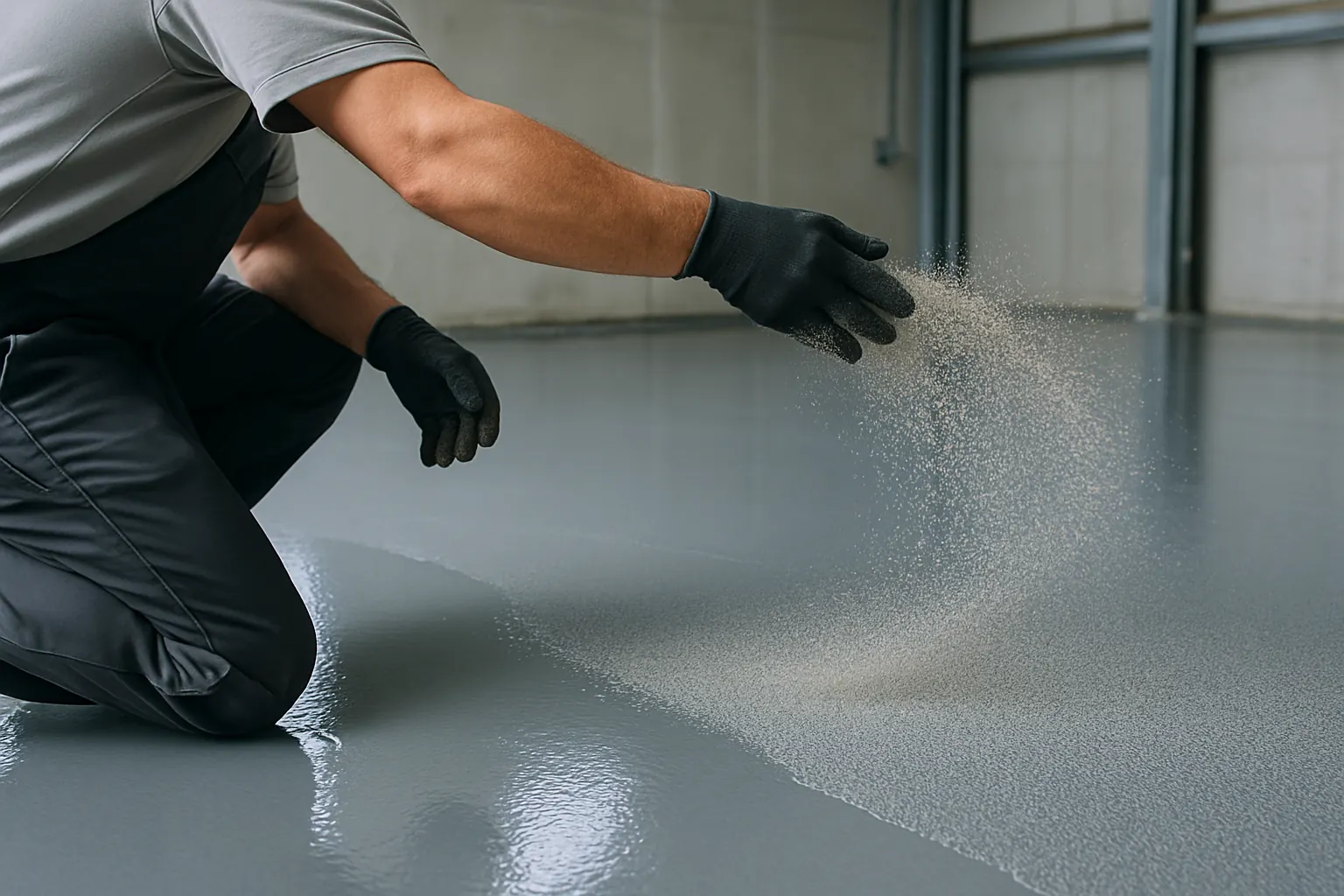
Resin chemistry — epoxy, polyaspartic, urethane — determines chemical resistance, cure speed and abrasion life. It does not, by itself, create meaningful slip resistance. A neat epoxy topcoat is glossy and slick when wet regardless of how good the epoxy is. Texture is engineered by broadcasting or blending aggregate into the system, then locking it under a topcoat.
Silica Sand
The most common and most economical option. Graded silica broadcast into the body coat produces anything from a light sandpaper feel to a coarse texture depending on mesh size and broadcast rate. Good general-purpose choice for warehouses, mechanical rooms and loading areas.
Aluminum Oxide
Harder and sharper than silica, so it holds its profile longer under heavy abrasion. Used in high-traffic ramps, dock aprons and areas that get scrubbed frequently. The trade-off is aggressiveness: it is hard on knees, mop heads and pallet-jack wheels if over-applied.
Quartz (Colored Ceramic-Coated)
Full-broadcast colored quartz builds a decorative, high-build system that is inherently textured. Popular where appearance and safety both matter — locker rooms, commissaries, food-prep areas, public-facing back-of-house. Because the quartz is broadcast to refusal, texture is uniform rather than spotty.
Polymer and Engineered Grits
Lighter-weight polymeric grit suspends well in the topcoat and produces fine, even texture without the aggressive bite of mineral aggregate. A good fit for corridors, clean rooms and retail spaces that need traction but must stay easy to disinfect.
Aggregate in the Urethane Cement Itself
Urethane cement slurry and mortar systems are already loaded with aggregate. Additional broadcast raises texture further for wash-down zones, which is standard practice in food and beverage facilities where the floor is wet and soapy for hours a day.
Choosing a Texture Level You Can Actually Clean
This is where most specifications go wrong in one direction or the other. Too smooth and the floor is a hazard when wet. Too coarse and the floor becomes a dirt trap that never comes clean, which eventually makes it slippery again from embedded soil and grease.
A workable way to think about it:
- Smooth / very light texture: Dry, clean environments — storage rooms, electronics assembly, showrooms, office-adjacent space. Easiest to clean, lowest wet traction.
- Light texture (fine broadcast): General warehouse aisles, dry manufacturing, corridors. Adds traction without materially raising cleaning effort.
- Medium texture (broadcast to refusal, sealed): Areas with occasional water, incidental spills, ramps, dock interiors. The most common industrial default.
- Heavy texture (coarse broadcast, thin topcoat): Continuous wet or greasy processing, wash-down zones, freezer entries, exterior-adjacent transitions. Requires deck brushes and automatic scrubbers with the right pad pressure.
Match the texture to the housekeeping program you actually have, not the one on paper. A heavy-texture floor cleaned with a string mop will collect grease in the profile and become more slippery than a medium-texture floor cleaned properly with a scrubber.
Zone the Building Instead of Coating It Uniformly
Very few facilities need one texture everywhere. Zoning by risk gives you better safety outcomes and lower cleaning cost at the same time.
In a beverage plant, that might mean heavy texture and coving in the filler room, medium texture in the ambient-temperature packaging area, and light texture in dry-goods storage. In a distribution center, it might mean aggressive texture on the ramp and dock apron where wet shoes and wheels enter, and lighter texture down the pick aisles.
Transitions between zones are where people slip. A person walking from a coarse wet-area floor onto a smooth dry-area floor with contaminated shoes is at the highest risk in the building. Put entry matting, a graduated texture change, or a physical drainage break at those thresholds rather than a hard line.
Systems, Build and Where Texture Lives in the Stack
A textured industrial floor is normally three layers: a primer that wets into the prepared concrete, a body coat carrying the aggregate, and a topcoat that locks the aggregate in and provides the wear and chemical surface.
The topcoat is what controls final texture. Flooding it fills the profile and produces a smoother floor; applying it thin leaves more of the aggregate proud and produces more bite. This is a field decision as much as a product decision, which is one reason we self-perform every step of the commercial epoxy installation process — the texture you asked for depends on how the last coat is pulled.
On the product side, the systems we install cover the range: National Shield 110 for chemically demanding service, National ArmourPro 120 for heavy-duty industrial build, ArmourPro UV 125 where sunlight reaches the floor, and NationalSeal Urethane High-Gloss 210 where a harder, brighter wear surface is wanted and traction is managed with suspended grit. Which one belongs in your building comes back to the process described in our guide to choosing the right floor coating system for your facility.
What Degrades Slip Resistance Over Time
Texture is not permanent. It wears, fills and gets buried. Common causes:
- Abrasion in traffic lanes. Forklift turn lanes and pick aisles polish the aggregate down faster than the rest of the floor. Traction becomes uneven across the same room.
- Soil and grease filling the profile. The floor still looks textured but the valleys are packed. Common in kitchens and fryer areas.
- Floor finish and sealer build-up. Applying an acrylic finish over a textured industrial floor can smooth it out and undo the specification entirely.
- Improper cleaning chemistry. Under-diluted degreaser left to dry leaves a slick residue film. Rinsing matters as much as scrubbing.
- Topcoat wear-through. Once the topcoat is gone, aggregate begins releasing and the floor loses both traction and protection.
Wear-through is worth catching early. Recoating a worn topcoat is routine maintenance; letting it fail into the body coat turns into full replacement, which is the pattern behind most cases in our review of why epoxy floors fail.
A Practical Slip-Resistance Program
Specification is one half. The other half is a documented routine.
- Map the building into texture zones and write the required texture level for each one.
- Set cleaning procedures per zone: chemical, dilution, equipment, pad or brush type, and rinse requirement.
- Field-test wet traction periodically in the highest-risk zones and log the results.
- Inspect for topcoat wear-through in traffic lanes quarterly, and schedule recoats before the body coat is exposed.
- Fix drainage and ponding as a facility issue, not a flooring issue — no texture compensates for standing water.
- Keep entrance matting long enough to actually dry shoes, especially through Chicago winters.
Frequently Asked Questions
Is there an OSHA-required coefficient of friction for industrial floors?
No single enforceable number applies across the board. The walking-working surfaces standard requires surfaces to be kept in a safe, clean condition and free of recognized hazards, with drainage and dry standing places where wet processes are used. The 0.5 figure often quoted comes from older advisory material rather than the enforceable requirement. Design to the actual contaminant conditions in each area and document what you did.
Can you add slip resistance to an existing epoxy floor without replacing it?
Often, yes. If the existing system is sound and well bonded, it can be mechanically abraded and given a new textured topcoat with broadcast or suspended aggregate. That is far less disruptive than a tear-out. If the existing floor is delaminating or contaminated, adding texture on top only postpones the failure.
Does more texture always mean a safer floor?
No. Past a certain point, added coarseness makes the floor harder to clean, and embedded grease or soil reduces traction more than the extra profile adds. It also increases wear on cleaning equipment and can create tripping and ergonomic complaints. The safest floor is the one with adequate texture for the contaminant present and a cleaning program that keeps that texture open.
What texture works in a commercial kitchen?
Kitchens combine water, grease, heat and frequent cleaning, so they generally need a heavy-texture urethane cement or a coarse-broadcast system with integral coved base and proper slope to drains. Grease is the hardest contaminant to design against, and drainage plus a real degreasing routine matter as much as the surface itself.
How often should a textured industrial floor be recoated?
It depends entirely on traffic and cleaning. Heavy forklift lanes wear their topcoat far faster than open storage in the same building. Rather than a fixed interval, inspect traffic lanes on a schedule and recoat when the topcoat is thinning but before the aggregate or body coat is exposed.
Are wet areas different in food plants versus general manufacturing?
Yes. Food and beverage areas add sanitation and thermal shock requirements on top of traction, which usually points to urethane cement with coved base. The specifics are covered in our guide to USDA/FDA and antimicrobial floors for food and beverage facilities.
Get Your Floor Assessed for Slip Risk
If you have had near-misses, an incident, or an insurance carrier asking questions, the fastest path forward is a walk-through that maps risk by zone and specifies texture accordingly. National Epoxy has been installing commercial and industrial floors for over 30 years, serving Chicagoland, Northwest Indiana and Southeast Wisconsin — including Chicago, Elk Grove Village and the surrounding industrial corridors.
Schedule a free on-site assessment and we will evaluate your existing surface, wet-area conditions and cleaning program, then put a texture specification in writing. Contact National Epoxy or call (630) 919-5000.