
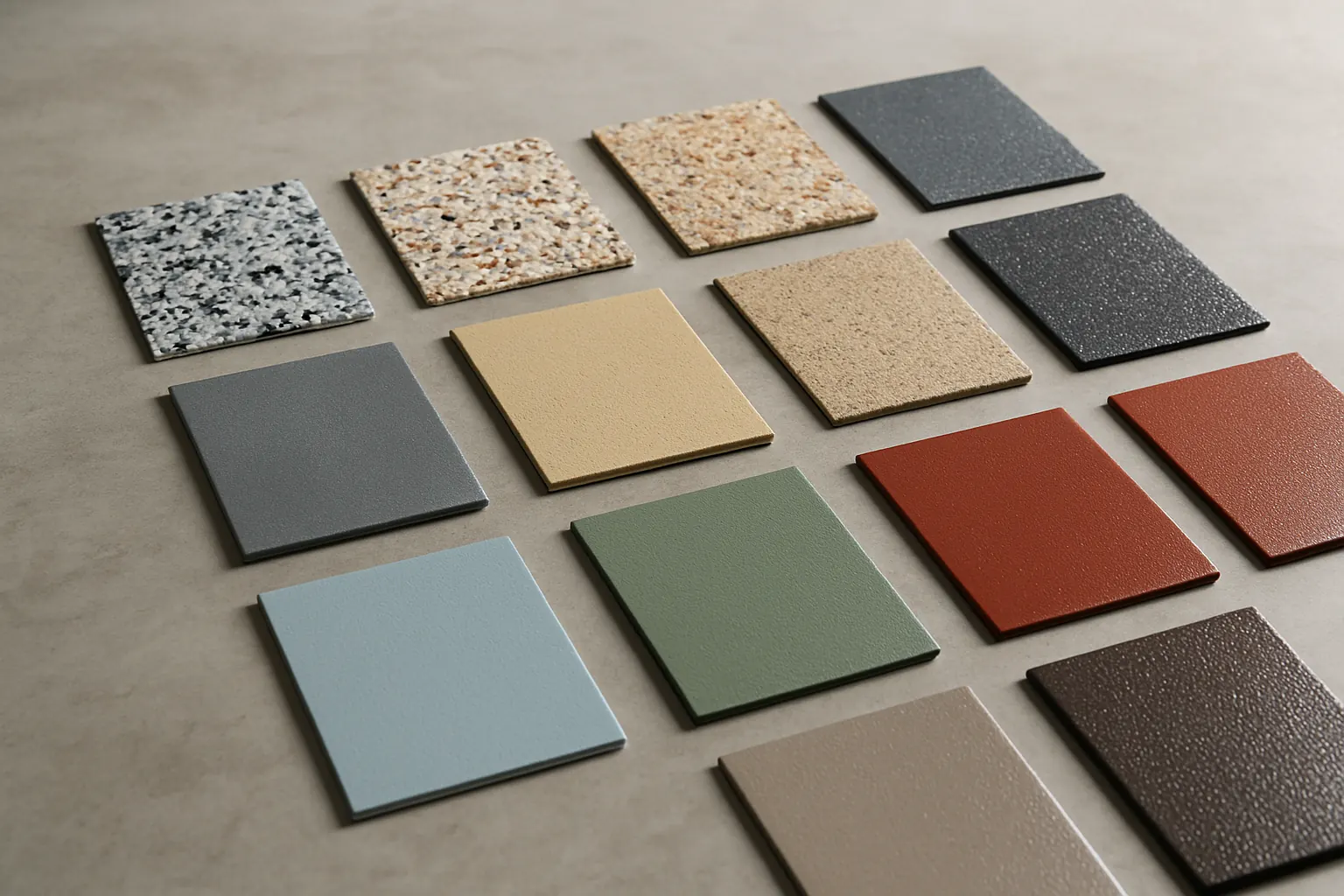
Most bad floor coating decisions are made in the first ten minutes of the conversation. Someone asks “how much for epoxy?” and gets a number, and the number becomes the spec. Six months later the floor is peeling at the dock door, hazing under the forklift lanes, or blistering where the slab never stopped giving up moisture.
Choosing a coating system is a specification problem, not a shopping problem. The substrate, the traffic, the chemicals, the temperature swings and the amount of downtime you can afford all narrow the field before price ever enters the picture. Get those inputs right and there are usually only two or three legitimate answers. Get them wrong and every system on the market will fail, just at different speeds.
This is the sequence we walk facility managers through across Chicagoland, from single-bay shops in Addison to 300,000 sq ft distribution centers. It works for any building, and it works whether you hire a commercial and industrial epoxy floor installer or handle the specification in-house.
Start With the Failure Mode, Not the Product
Ask a different first question: how would this floor most likely fail?
In a warehouse, the honest answer is usually abrasion and impact at the dock, plus hot-tire pickup where trucks park. In a commercial kitchen, it is thermal shock and grease penetration at the joints. In a plating room, it is chemical attack and undercutting at the base of the wall. In an aging building with no vapor barrier under the slab, it is moisture-driven delamination that has nothing to do with the coating chemistry at all.
Once you can name the failure mode, the system almost specifies itself. We covered the most common ones in detail in our breakdown of why epoxy floors fail and how to prevent it, and the pattern is consistent: the great majority of failures trace back to substrate conditions and prep, not to the resin someone selected.
Step 1: Document What the Floor Actually Does All Day
Before you look at a single data sheet, write down the operating conditions. Not the general use of the building, the specific conditions in each zone.
Mechanical Load
Pneumatic-tire pallet jacks, steel-wheeled carts, forklifts with hard polyurethane wheels and turret trucks all load the surface differently. Steel wheels concentrate load into a tiny contact patch and will gouge a thin-film coating that survives rubber tires indefinitely. Point loads from racking posts, die carts and pallet drops matter too — a system with good compressive strength but low impact resistance chips at exactly those spots.
Chemical Exposure
List the actual chemicals, concentrations and dwell times. There is a large practical difference between an occasional hydraulic oil drip that gets wiped up and a sanitizer that pools in a low spot every night. Standard epoxies handle oils, greases, most solvents and dilute alkalis well. Concentrated acids, aggressive solvents and hot caustics need a novolac epoxy or a urethane cement, not a general-purpose system.
Thermal Exposure
Thermal shock is the quiet killer. Concrete and coatings expand at different rates, so hosing a 150°F wash-down over a coated slab or dropping steam-cleaned equipment onto it puts real stress on the bond line. Any area with steam cleaning, boil-out, autoclaves or freezer-to-ambient transitions should be looked at as a thermal problem first.
Moisture and Vapor Drive
Moisture vapor emission is the single most under-tested variable in commercial flooring. Slabs poured on grade without an intact vapor retarder can push vapor upward for the life of the building. If moisture vapor emission rate (MVER) or internal relative humidity exceeds what the system tolerates, the coating will blister and delaminate regardless of how well it was applied.
Aesthetics, Light and Compliance
Gloss level, color, reflectivity and markings are not vanity items in every building. Distribution centers use high-gloss finishes to cut lighting load. Healthcare and food plants need seamless, cleanable surfaces. Manufacturing floors need durable striping that survives scrubbers. Decide this early, because it affects topcoat selection.
Step 2: Test the Substrate Before You Spec Anything
The concrete is half the system. Testing it is cheap relative to a re-do.
- Moisture: ASTM F2170 in-situ relative humidity probes and/or ASTM F1869 calcium chloride testing. RH probes are more reliable on slabs that have been covered.
- Bond strength: ASTM D7234 pull-off testing to confirm the surface layer is sound and not a weak, over-troweled skin.
- Contamination: A simple water-drop test shows whether oil, silicone or old curing compound is blocking penetration. Deeply oil-soaked concrete in maintenance bays may need degreasing and, in bad cases, removal.
- Flatness and drainage: Ponding water in a wash-down area is a design problem a coating cannot solve. Slope corrections belong in the scope, not in the complaint call a year later.
- Existing coatings: Identify what is down and how well it is bonded. Sound, well-bonded coatings can sometimes be over-coated after aggressive profiling; failing ones have to come off.
Test results dictate prep. Prep dictates adhesion. This is why our crews self-perform every step of the commercial epoxy installation process rather than subbing out the grinding — the people who profile the slab are the people accountable for the bond.
Step 3: Match the Resin Chemistry to the Job
There is no single best chemistry. Each one trades something. The table below is a working summary of how the main families behave in commercial and industrial service.
| Chemistry | Typical strengths | Typical limits | Common use |
|---|---|---|---|
| Epoxy (100% solids) | Adhesion, build, chemical resistance, cost efficiency | Ambers under UV; slower cure in cold | Warehouse, manufacturing, body of the system |
| Polyaspartic / polyurea | Fast cure, low-temperature application, UV stability, abrasion | Short working time; thin build per coat | Fast-turnaround topcoats, cold spaces |
| Urethane (aliphatic topcoat) | UV and abrasion resistance, gloss retention, chemical topcoat | Not a standalone build layer | Wear coat over epoxy body |
| Urethane cement / mortar | Thermal shock, steam and hot wash-down, aggressive chemicals | Higher cost; textured, utilitarian look | Food and beverage, breweries, wet processing |
| MMA (methyl methacrylate) | Cures in hours, even below freezing | Strong odor during install; specialized crews | Coolers, freezers, extreme downtime limits |
Most real systems are hybrids: an epoxy body for build and adhesion, a urethane or polyaspartic topcoat for wear and UV. If you want the trade-offs laid out in more depth, see our comparison of epoxy vs. polyaspartic vs. urethane coatings.
The systems we install through NexGen Polymers map to this logic directly. National Armour 100 and National Armour 105 serve as high-build epoxy bodies. National Shield 110 and the National ArmourPro 120 build addresses heavier industrial duty, ArmourPro UV 125 handles UV-exposed areas, and NationalSeal Urethane High-Gloss 210 is a wear-and-gloss topcoat rather than a standalone floor.
Step 4: Decide Thickness and Build
Thickness is where budget pressure does the most damage. A roll-applied system at 10–20 mils is a coating; a broadcast or troweled system at 1/8″ to 1/4″ is a floor. They do not perform alike and should not be compared on price per square foot as if they did.
- Thin-film (roughly 10–25 mils): Light traffic, clean areas, showrooms, storage, back-of-house retail. Economical, fast, limited to relatively smooth substrates.
- Mid-build broadcast (roughly 30–125 mils): Quartz or vinyl-flake broadcast systems. The workhorse for most warehouses, plants and commercial kitchens. Adds texture, hides minor substrate variation and gives real wear life.
- Heavy-duty mortar (1/4″ and up): Troweled epoxy or urethane mortar for impact zones, wash-down areas, and slabs too degraded to skim. Also used to rebuild profile and slope.
Rule of thumb: the rougher the concrete and the harder the service, the more build you need. Thin systems over rough slabs telegraph every defect and wear through at the high points first.
Step 5: Specify the Surface, Not Just the System
Two floors can use the same resin and behave completely differently based on what happens at the surface.
Texture. Aggregate broadcast raises slip resistance but also raises cleaning effort. Wet-process areas need it; a pharmacy clean corridor generally does not. That balance is worth reading about in detail in our guide to slip resistance, aggregates and OSHA compliance.
Coving. Integral coved base eliminates the floor-to-wall joint where water, product and bacteria collect. It is essentially mandatory in food, beverage and life-science spaces and useful anywhere a floor gets flooded or hosed.
Markings. Aisle striping, safety zones, equipment footprints and pedestrian walkways should be embedded under the topcoat, not painted on top after the fact. Embedded markings survive scrubbers and forklift wear; surface-applied tape and paint do not.
Joints. Control joints and construction joints move. Honor them, fill them with the correct flexible material, and do not simply bridge them with rigid coating and hope.
Step 6: Work Backward From Downtime
The best-performing system is worthless if you cannot take the building offline long enough to install it. Downtime should be an input to the specification, not an afterthought.
Standard epoxy builds generally need overnight recoat windows and several days before full chemical service. Polyaspartic and MMA systems can return a space to foot traffic in hours, which is why they show up in coolers, hospitals, grocery and 24/7 operations. Sequencing helps too: most large facilities get coated in phases, working around production, with dust-controlled grinding and containment so adjacent areas keep running.
Weather matters in Chicagoland more than people expect. Slab temperature drives cure. In an unheated warehouse in Elk Grove Village in January, an epoxy that cures fine at 70°F may not cure properly at all — which is why cold-weather work often shifts to polyaspartic or requires temporary heat.
A Quick Reference by Facility Type
- Warehouse and distribution: Mid-build epoxy body with a urethane wear coat, heavier build at docks and turn lanes. See retail and warehousing flooring.
- Manufacturing and metalworking: High-build epoxy or mortar in impact zones, chemical-resistant topcoat, embedded safety markings. See industrial flooring.
- Food, beverage and commercial kitchens: Urethane cement with integral coving and aggressive texture. See food and beverage flooring.
- Healthcare and life sciences: Seamless, cleanable, low-VOC systems with coved base and controlled texture. See healthcare flooring.
- Automotive service and dealerships: Hot-tire-resistant build with UV-stable topcoat where daylight reaches the floor. See automotive flooring.
Red Flags in a Coating Proposal
When you compare bids, the differences that matter are rarely on the first page.
- No mention of moisture testing, or moisture testing offered as a change order after demolition.
- Prep described as “clean and prep” with no method — diamond grinding and shot blasting produce different profiles, and acid etching is not a substitute for either.
- No stated surface profile (CSP) target for the specified build thickness.
- Thickness given as a product name instead of a mil or fraction-of-an-inch value.
- No written cure schedule tied to return-to-service for foot traffic, vehicle traffic and chemical exposure.
- Crack, joint and transition detailing left out entirely.
- Prep and installation subcontracted to a different company than the one signing the proposal.
A proposal that addresses all seven may look more expensive than one that ignores them. It usually is not — the ignored items reappear later as change orders or as a floor that has to be redone.
Frequently Asked Questions
Can I put a new coating over my existing epoxy floor?
Sometimes. If the existing coating is well bonded across the area, compatible with the new system and can be mechanically abraded to accept it, an over-coat can work and saves removal cost. If it is delaminating, contaminated, or of unknown chemistry, removal is the safer path. Pull-off testing and a test patch answer this quickly.
How long should a commercial epoxy floor last?
Service life depends far more on build thickness, traffic and maintenance than on brand. A thin-film coating in a busy warehouse may show wear within a couple of years, while a properly prepped, high-build system in the same building can perform for many years with periodic topcoat renewal. Planning a topcoat refresh cycle is generally cheaper than waiting for the body coat to wear through.
Do I need moisture mitigation on a 40-year-old slab?
You need testing before you can answer that. Older slabs sometimes test low because they have dried for decades, and sometimes test high because they were poured over a poor or missing vapor retarder and sit in wet soil. Age alone predicts nothing; the test result does.
What is the difference between a coating and a flooring system?
In practice, thickness and function. A coating protects and seals the concrete surface. A system at high build with aggregate becomes a wearing surface in its own right, capable of taking impact and abrasion the concrete itself could not.
How much does this cost?
It varies widely with system, thickness and prep required. We break down the ranges and the variables behind them in our guides to commercial epoxy flooring cost per square foot in Chicagoland and what actually drives industrial floor coating cost.
Get a Specification Built Around Your Facility
The right system for your building depends on conditions no data sheet can tell you. National Epoxy has spent over 30 years installing commercial and industrial floors across Chicagoland, Northwest Indiana and Southeast Wisconsin, and our crews self-perform every step from testing and prep through topcoat.
Schedule a free on-site assessment and we will test the slab, review your operating conditions and put a specific system, thickness and schedule in writing. Contact National Epoxy or call (630) 919-5000.