
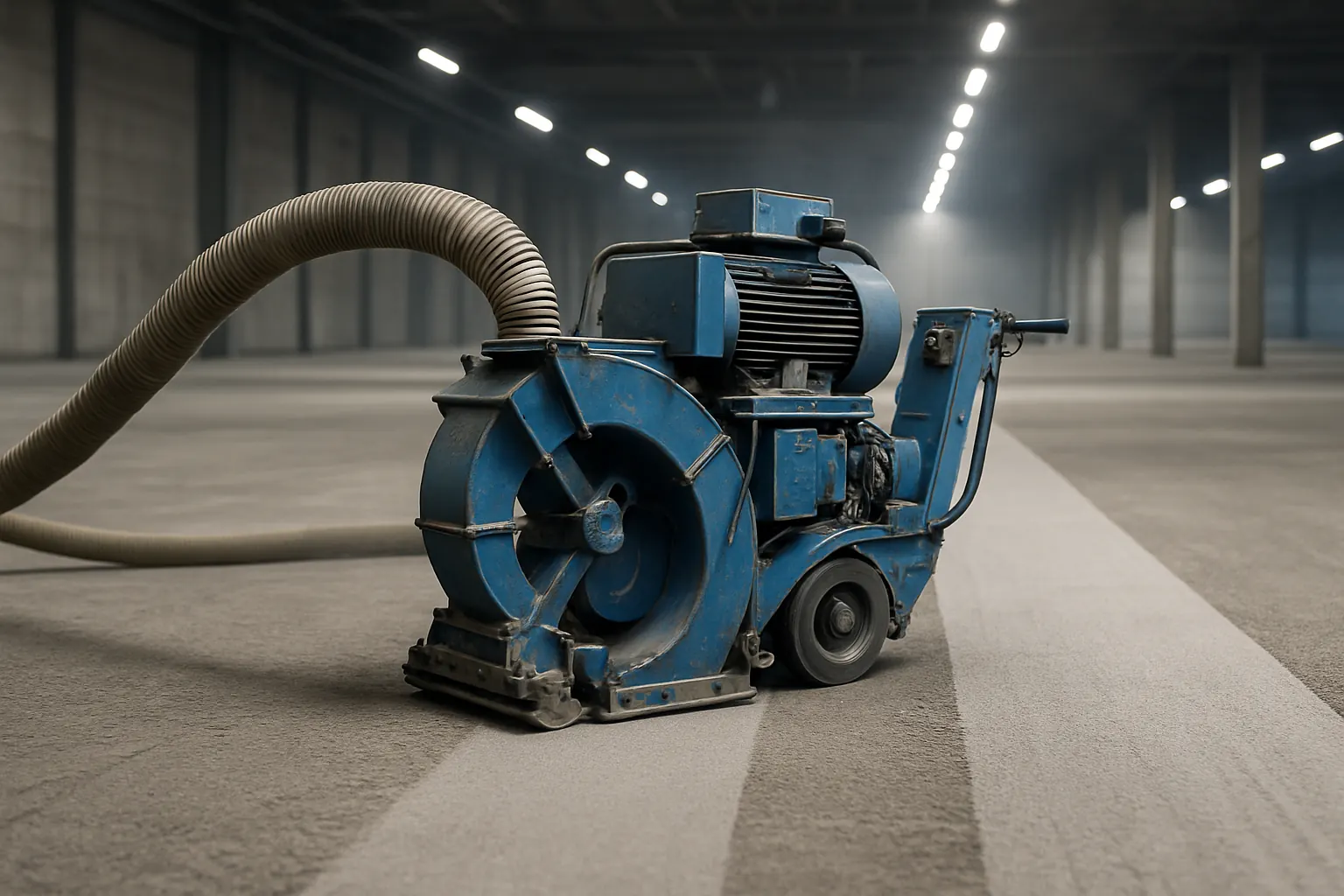
Surface preparation is the part of an epoxy floor project that nobody sees and everybody pays for twice when it is done wrong. It is also the single largest variable separating a floor that performs for a decade from one that peels off in sheets before the warranty paperwork is filed.
Epoxy does not glue itself to concrete chemically. It bonds mechanically — it flows into an opened, textured surface and locks in. No texture, no bond. That is the entire premise of surface prep, and it is why the choice between diamond grinding, shot blasting, scarifying, and acid etching is a technical decision rather than a preference.
This article covers what surface profile means and how it is measured, how each preparation method works, where each one belongs, what they cost in time and disruption, and why acid etching has largely no place in commercial and industrial work.
Surface Profile: The Number That Governs Everything
The International Concrete Repair Institute defines Concrete Surface Profile (CSP) on a scale of 1 to 9, from nearly smooth (CSP 1) to very rough (CSP 9). Each level has a corresponding rubber replica coupon you hold against the prepared slab to verify what you actually produced.
The rule of thumb the industry works from: the thicker the system, the deeper the profile it needs.
| System type | Typical thickness | Target CSP | Usual method |
|---|---|---|---|
| Thin-film sealers, penetrating primers | Under 3 mils | CSP 1–2 | Fine diamond grinding |
| Standard epoxy coating | Roughly 4–10 mils | CSP 2–3 | Diamond grinding |
| High-build epoxy | Roughly 10–30 mils | CSP 3–4 | Grinding or light shot blasting |
| Broadcast quartz / flake systems | Roughly 30–125 mils | CSP 4–5 | Shot blasting |
| Self-leveling slurry | Roughly 1/8″ | CSP 4–6 | Shot blasting |
| Urethane and epoxy mortars | Roughly 1/4″ and up | CSP 6–9 | Aggressive blasting or scarifying |
Two things about that table matter more than the numbers themselves. First, the target belongs to the system’s data sheet — verify there, not here. Second, profile has to be uniform across 100% of the coated area. A slab prepared beautifully in the open bays and scuffed casually along the walls will fail along the walls, which is exactly the pattern described in our article on epoxy floor peeling and delamination.
What prep also has to remove
Profile is only half the job. Preparation also has to eliminate everything that would act as a bond breaker:
- Laitance — the weak, fines-rich layer that rises during finishing and has almost no tensile strength.
- Curing compounds applied to new slabs. They are membrane-formers, which is to say bond breakers.
- Sealers, silicates, and densifiers from previous owners.
- Existing coatings, whether failing or intact.
- Embedded oil and contamination, at least to the depth the method reaches.
- The dust prep itself generates — vacuumed out of the profile, not left sitting in it.
Diamond Grinding
Diamond grinding uses rotating heads fitted with diamond-impregnated segments to abrade the surface. Segment bond hardness and grit are matched to the concrete: soft-bond tooling for hard concrete, hard-bond for soft concrete — a detail that separates crews who grind for a living from crews who rented a machine.
Where grinding is the right call
- Producing controlled, moderate profiles in the CSP 1–4 range.
- Removing thin coatings, adhesives, mastic, and thin-film sealers.
- Flattening high spots, trowel ridges, and slab transitions.
- Occupied buildings and finished spaces — grinding paired with a high-CFM HEPA vacuum is genuinely near dust-free.
- Edges, corners, perimeters, stairs, and confined areas where a shot blaster cannot physically reach.
- Healthcare, laboratory, and retail environments where dust containment is not negotiable.
Limitations
Grinding is slower than shot blasting on large open areas, and it produces a comparatively shallow profile. Pushing a grinder to produce CSP 5 or deeper is inefficient and hard on tooling. Grinding also tends to polish rather than open the surface if the tooling is wrong for the concrete — a smooth, burnished result that looks prepped and is not. On thick, well-bonded coatings, grinding can load up and glaze tooling quickly.
Shot Blasting
A shot blaster propels steel shot at the slab with a centrifugal wheel, then recovers the shot magnetically and recycles it while a dust collector pulls the debris. Profile depth is controlled by shot size, wheel speed, and travel speed.
Where shot blasting is the right call
- Large open areas — warehouse floors, plant floors, distribution centers — where its production rate is dramatically higher than grinding.
- Producing aggressive profiles in the CSP 4–7 range for broadcast systems, slurries, and mortars.
- Removing laitance and curing compounds efficiently across big footprints.
- Delivering a clean, dry, ready-to-coat surface immediately behind the machine.
- Projects where the schedule is the constraint — a large industrial floor can be prepared in a fraction of the grinding time.
Limitations
Shot blasters cannot reach edges, corners, or tight areas, so every shot-blasting job also requires grinding for perimeters and detail work. They struggle with soft or thick elastomeric coatings, which absorb the shot rather than shattering. They can produce visible tracking lines if operated carelessly. They are heavy, require power the building may not have available, and are loud enough that occupied adjacent space may need scheduling around.
Shot blasting also has a real failure mode: over-blasting. Too aggressive a profile for the system means the coating cannot fill the valleys, and the peaks telegraph through the finished floor or, worse, leave voids at the peaks that show up later as pinholes — a mechanism covered in our article on bubbles, pinholes, and fisheyes.
Acid Etching: Why It Is Not a Commercial Method
Acid etching applies a dilute acid — typically muriatic or a phosphoric blend — to react with and dissolve the cement paste at the surface, then neutralizes and rinses it. It is popular in the consumer market because it requires no equipment and it is cheap.
It is also, for commercial and industrial work, essentially indefensible. The problems are structural, not a matter of technique:
- It does not produce a reliable profile. Etching typically achieves CSP 1–2 at best, and unevenly, because it attacks paste and not aggregate. Hard-troweled areas barely respond.
- It does not remove bond breakers. Curing compounds, sealers, oil, and existing coatings all shrug it off — and by shielding the concrete, they leave those areas completely unetched.
- It leaves residue. Incomplete neutralization and rinsing leaves salts on the surface that interfere with bond directly.
- It adds water to the slab. Rinsing drives water into concrete that then has to dry before coating, which is the opposite of what you want, especially on a slab already flagged in moisture testing.
- It creates handling, disposal, and worker-safety obligations that a commercial facility does not need.
- It cannot be verified. There is no way to confirm you achieved a uniform profile across a 30,000 square foot slab.
Most coating manufacturers now specify mechanical preparation and exclude acid etching from their warranty requirements. If a bid for a commercial floor includes etching as the preparation method, that is the line item to question.
Scarifying, Scabbling, and Milling
For heavy removal, the aggressive mechanical methods have their place. Scarifiers use rotating drums with hardened cutters to plane material off, producing very deep profiles in the CSP 6–9 range. Shot blasting cannot compete with them for removing thick, well-bonded coatings, heavy epoxy mortars, or badly deteriorated surface concrete.
The trade-off is that they leave a rough, grooved, uneven surface that almost always needs follow-up grinding or blasting before coating. They are removal tools, not finishing tools. Use them as step one on a heavy demolition scope, not as the entire prep.
Choosing a Method: A Practical Comparison
| Factor | Diamond grinding | Shot blasting | Acid etching |
|---|---|---|---|
| Typical CSP achieved | 1–4 | 3–7 | 1–2, inconsistent |
| Production rate, open area | Moderate | High | Fast but ineffective |
| Removes coatings and sealers | Yes, thin to moderate | Yes, brittle coatings | No |
| Removes laitance | Yes | Yes | Partially |
| Edges and corners | Yes | No — needs grinding | Yes, but ineffective |
| Dust control | Excellent with HEPA vacuum | Good, integrated collector | No dust; adds waste water |
| Adds moisture to slab | No | No | Yes |
| Profile verifiable | Yes, ICRI coupons | Yes, ICRI coupons | Not reliably |
| Appropriate for commercial work | Yes | Yes | No |
In real projects the answer is usually both of the first two. A typical industrial installation runs the shot blaster across the open field for speed and profile depth, then grinds the perimeter, the corners, around columns and equipment pads, and any area the blaster could not reach — matching the profiles so the transition is invisible to the coating.
What Comes After Prep, and Why It Matters
A perfectly profiled slab can still produce a failed floor if the steps between prep and priming are handled sloppily.
- Verify the profile against ICRI replica coupons in multiple locations, including perimeters. Document it.
- Vacuum thoroughly. Dust left in the profile is a bond breaker sitting exactly where the bond is supposed to happen.
- Repair after profiling, not before. Cracks, spalls, bugholes, and joints get addressed once the sound concrete is exposed, using materials compatible with the coating.
- Confirm the slab is clean. A water-drop test across the floor catches contamination that survived prep.
- Confirm moisture status. Prep does not change vapor drive; testing and mitigation are separate work.
- Prime promptly. A prepared slab sitting open for days collects dust, forklift traffic, and airborne contaminants.
Because our crews self-perform every step of a commercial epoxy installation, prep is not handed off to a subcontractor whose scope ends the moment the machine leaves the building. The people who profiled the slab are the people who have to make the coating stick to it.
Facility Realities That Change the Prep Plan
Method selection is not purely technical. Operating conditions drive it too.
- Occupied or adjacent-occupied space. Grinding with HEPA containment is often the only viable option next to active production or patient care areas.
- Sanitary environments. Food and beverage and pharmaceutical facilities require containment protocols, and coving and drain detail work adds edge grinding beyond the field area.
- Contamination history. A 40-year-old maintenance bay with oil an inch into the slab needs remediation planned before prep, not discovered during it.
- Shutdown windows. If the floor has to be back in service Monday, production rate drives the method, and shot blasting frequently wins.
- Power availability. Large blasters need three-phase power the building may not have where you need it. Generators change logistics and cost.
- Post-tensioned slabs. Scarifying and deep removal require knowing where the tendons are.
Frequently Asked Questions
Can I skip preparation if my concrete is brand new and clean?
No — new concrete is often the worst case. A freshly power-troweled slab is dense and closed, offering almost nothing to bond to, and most new slabs have been sprayed with a curing compound that is a deliberate bond breaker. New slabs also carry construction moisture. Clean and new does not mean ready.
How do I verify a contractor actually achieved the right profile?
Ask for ICRI replica coupons and a written record of profile verification at multiple locations, including perimeters and under-equipment areas. It takes minutes, costs nothing, and is the difference between a documented scope and a claim. Any contractor who cannot answer what CSP they are targeting for your system is telling you something.
Is shot blasting always better than grinding?
No. Shot blasting is faster and more aggressive, which makes it right for large open areas and thick systems and wrong for thin-film systems, tight spaces, and situations where an over-aggressive profile would telegraph through the finish. Most industrial projects use both.
How long does surface prep take on a commercial floor?
It depends on square footage, method, what has to be removed, and how much detail work the space contains. A large open warehouse floor prepared by shot blasting moves far faster than the same square footage in a partitioned facility full of columns, equipment pads, and drains. Removal of an existing failed coating can easily take longer than everything else combined, which is why the condition of what is already down belongs in the site walk, not in the assumptions.
Does deeper profile always mean better adhesion?
Only up to the point that matches the system. An over-aggressive profile under a thin coating leaves peaks that the film cannot cover, producing early wear-through, telegraphing, and pinholes at the high points. Match the profile to the system rather than maximizing it.
What if the slab is contaminated or emitting moisture?
Those are separate problems that preparation does not solve. Contamination requires remediation and sometimes concrete removal; vapor drive requires testing and a rated mitigation membrane. Both are covered alongside the other root causes in why epoxy floors fail, and further technical material is collected in our knowledge base. System selection follows from that assessment — high-build traffic systems like National Armour 100 and chemical-duty systems such as National PolyGuard 200 carry different prep requirements.
Get the Prep Specified Correctly From the Start
Preparation is where a floor is won or lost, and it is the easiest line item to underbid. National Epoxy has been preparing and installing commercial and industrial floors for over 30 years, with crews that self-perform grinding, blasting, repair, and application on every project.
We work throughout Chicagoland and into Northwest Indiana and Southeast Wisconsin, including Chicago, Naperville, and the rest of our service area. Reach us through our contact page or call (630) 919-5000 to walk your slab and scope the preparation honestly.